
Auto Bearing Torque Reference Table Wholesale Supplier
“Hand-tight plus a quarter turn” is not a safety margin; it is a recipe for microscopic raceway spalling.
The definitive answer to preventing premature bearing failure lies in strict adherence to the Auto Bearing Torque Reference Table. Subjective manual tightening, regardless of the mechanic’s experience, cannot replicate the precise axial preload required for tapered roller and heavy-duty wheel bearings. Proper installation requires distinguishing between initial nut torque, axle rotation resistance, and final locking mechanisms, verified through axial end-play measurement rather than guesswork.
I still recall the humid heat of a workshop in Monterrey, where a fleet manager watched his heavy trucks return with seized wheel hubs after barely twenty thousand kilometers. The maintenance crew had relied on tactile feedback to tighten the locknuts, assuming that increased resistance equated to security. Instead, they had created excessive internal friction that destroyed the oil film, leading to thermal runaway. That incident shifted my focus from mere parts distribution to technical data integrity. In high-load environments, especially across Latin America’s demanding routes, the difference between a successful overhaul and a catastrophic breakdown often rests on a few Newton-meters of deviation.
Understanding these dynamics is critical for distributors and MRO operators who supply workshops. Without accurate technical guidance, even genuine premium bearings fail prematurely, damaging reputations and causing significant financial loss for end-users.
Why Do Auto Bearing Torque Specs Matter?
Subjective tightening remains the primary driver of aftermarket bearing claims, yet it persists due to a lack of accessible, reliable technical documentation. Many workshops operate under the misconception that higher torque eliminates play, failing to recognize that over-torquing crushes the rolling elements and prevents proper lubrication circulation.
When a bearing is installed with excessive preload, the internal clearance becomes negative. This forces the rollers or balls to carry loads they were not designed to sustain statically, generating intense heat. Conversely, under-torque allows axial movement, causing the bearing to hammer against its seats during braking and acceleration. Both scenarios lead to rapid degradation.
In my experience supplying parts to mining and construction sectors, I have seen how mixed-batch assembly errors compound this issue. When technicians use generic specifications for precision tapered rollers instead of model-specific data, rejection rates climb noticeably. A European wind farm operator once reported that their gearbox replacements failed within months because the installation team applied standard industrial torque values to high-precision automotive-grade units. The mismatch in tolerance requirements led to immediate vibration issues.
For suppliers, providing an Auto Bearing Torque Reference Table is not just about sharing numbers; it is about offering a safeguard against these costly misinterpretations. It transforms a commodity transaction into a technical partnership, ensuring that the end-user understands the gravity of proper installation.
How to Read a Bearing Torque Reference Table?
Interpreting a torque specification sheet requires more than reading a single number. A comprehensive Auto Bearing Torque Reference Table distinguishes between several critical phases of installation: initial nut torque, rotational torque check, and final locking mechanism engagement. Confusing these stages leads to incorrect preload settings.
| Installation Phase | Parameter Type | Verification Method | Risk of Error |
|---|---|---|---|
| Initial Nut Tightening | Static Torque (Nm) | Torque Wrench | Over-compression of races |
| Rotational Check | Drag Torque (Nm) | Dial Indicator/Force Gauge | Misinterpretation of friction |
| Final Locking | Angle/Position | Visual/Marking | Loosening during operation |
| End-Play Check | Axial Clearance (mm) | Feeler Gauge/Magnetic Base | Incorrect preload setting |
The initial nut torque is merely a starting point to seat the bearing components. It does not represent the final operating condition. After applying this initial torque, the hub must be rotated multiple times to ensure the rollers are properly aligned within the cups. Only then can the true rotational drag be measured.
A common mistake observed in Asian automotive repair groups is skipping the rotation step. Technicians tighten the nut to the specified value and immediately lock it. This leaves the bearing misaligned, creating uneven load distribution that accelerates wear. By contrast, a correct procedure involves backing off the nut slightly after initial seating, then re-tightening to a lower “setting torque” while monitoring axial end-play.
Distributors who provide clear, step-by-step breakdowns in their Auto Bearing Torque Reference Table help workshops avoid these pitfalls. It clarifies that the “torque” listed in many catalogs is often the maximum allowable for the thread strength, not the optimal preload for the bearing itself.
What Are the Consequences of Incorrect Preload?
The consequences of deviating from recommended preload settings are severe and often immediate in heavy-duty applications. Analyzing failure modes reveals two distinct paths: burnout from under-torque and spalling from over-torque.
Under-torque results in excessive axial play. As the vehicle moves, the wheel hub shifts longitudinally, causing the bearing to impact its housing repeatedly. This generates shock loads that fracture the cage or crack the outer ring. In high-temperature routes, this play allows contaminants to enter the seal more easily, compounding the damage. A Middle East steel mill reported that their transport fleet experienced a surge in wheel-end failures during summer months, directly linked to mechanics loosening preload to reduce initial drag, ignoring the thermal expansion requirements.
Over-torque, on the other hand, destroys the lubricant film. The excessive pressure squeezes out the grease or oil, leading to metal-to-metal contact. This generates intense heat, causing the bearing steel to lose its hardness and deform. The result is instantaneous thermal runaway, where the bearing seizes completely, often taking the axle shaft with it. This type of failure is catastrophic and expensive, requiring extensive repairs beyond simple bearing replacement.
Using a reliable Auto Bearing Torque Reference Table helps mitigate these risks by providing temperature-compensated preload calculations where applicable. For instance, in environments with extreme ambient variations, standard room-temperature torque specs may need adjustment. Suppliers who offer cross-brand equivalent consultation can guide customers toward the correct specifications for their specific operating conditions, ensuring that the chosen bearing matches the application’s thermal and load profile.
How to Verify Torque During Assembly?
Verification is the only way to ensure that the theoretical torque values translate into practical reliability. Relying solely on a click wrench is insufficient for precision tapered roller bearings. The gold standard involves measuring axial end-play and rotational torque after assembly.
- Clean and Lubricate: Ensure all threads and bearing surfaces are clean and lightly lubricated. Dry threads create false torque readings due to friction.
- Initial Seating: Tighten the adjusting nut to the specified initial torque while rotating the hub. This seats the rollers firmly against the races.
- Back-off and Reset: Loosen the nut completely, then retighten to the lower “final setting torque.” This step removes the binding caused by initial seating.
- Measure End-Play: Use a dial indicator mounted on the spindle to measure axial movement. The value should fall within the manufacturer’s specified range, typically a small positive clearance.
- Check Rotational Torque: Rotate the hub and measure the force required. It should be smooth and consistent, without rough spots or binding.
A US buyer once shared how implementing this verification process reduced their warranty claims significantly. Previously, their technicians tightened to spec and assumed correctness. By adding the end-play check, they identified that nearly thirty percent of their “correctly” torqued bearings were actually over-preloaded due to thread variances.
Providing an Auto Bearing Torque Reference Table that includes these verification steps empowers workshops to move beyond guesswork. It shifts the culture from “tighten until it feels right” to “measure until it meets spec.” For distributors, this technical support becomes a key differentiator, building trust with clients who value reliability over lowest price.
Conclusion
Precision in bearing installation is non-negotiable for operational safety and longevity.
Adhering to a verified Auto Bearing Torque Reference Table prevents the subjective errors that lead to premature failures. By understanding the distinction between static torque and dynamic preload, and by verifying installation through end-play measurement, workshops can ensure optimal performance. Suppliers who integrate this technical depth into their service offerings provide indispensable value to global MRO and automotive sectors.
Mentioned in this article
Koyo / JTEKT bearings from this guide
These are the Koyo / JTEKT bearing types discussed above. Open any product to check its details, or quote it together with the rest of your repair.

Tapered Roller Bearings
P5 Koyo 33010 30211 33110 32307 33208 Tapered Roller Bearing for Motor Auto Pump
View Product
Tapered Roller Bearings
Jtekt Koyo Tapered Roller Bearing 32010 30302 30303 30304 30305 30306 for Auto Parts
View Product
Railway Bearings
X&S 30304 30306 30307 Tapered Roller Bearings for Railway Axle Auto Parts
View Product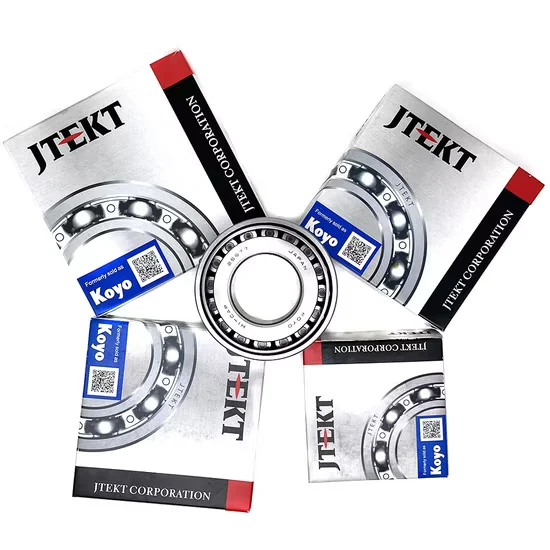
Tapered Roller Bearings
Koyo Tapered Roller Bearing 30203 30204 30205 30206 30207 for Auto Parts Wholesale
View ProductKeep reading
More bearing selection guides for repair shops
Practical guides from KOYO Bearing Supplier on identifying Koyo / JTEKT bearings for farm machinery, construction equipment and power transmission repairs.
 Technical Resources
· 7 min read
Auto Bearing Glossary: Wholesale Supplier for Bulk & MRO Parts
Master the auto bearing glossary to decode suffix codes and prevent costly MRO replacement failures. Identical dimensions do not guarantee interchangeability, as internal clearance…
Read the Guide Technical Resources
· 8 min read
Needle Bearing Fit & Tolerance Table: Wholesale Supplier for Bulk Orders
Master the needle bearing fit and tolerance table to prevent seizure caused by overly tight fits. Match ISO shaft and housing classes while verifying…
Read the Guide Technical Resources · 8 min read
OE to Koyo Bearing Cross Reference Table for Wholesale Bulk Supply
Stop relying on base numbers alone with our OE to Koyo cross reference table. Verify critical suffixes, clearances, and seals to prevent premature failure…
Read the Guide
Bearing enquiry
Send your machine details. Get a written Koyo / JTEKT quote.
KOYO Bearing Supplier quotes a single bearing position or every bearing in an assembly on one enquiry, matched to your machine model and application, with model, quantity, price, lead time and quote validity in writing.
- WhatsApp+1 (702) 981-5880
- Emailinfo@koyoome.com
- Address8 Research Drive, Greenville, SC 20627, USA
"When a Koyo bearing failed on a harvest machine during the season, we needed a replacement urgently. The supplier identified the correct Koyo reference, shipped same-day, and the machine was back in the field within the day."

Request a Bearing Quote
Tell us the machine and the bearing position. Photos of the markings can follow on WhatsApp.