
Koyo Auto Part Number Decoder: Wholesale Supplier for Bulk Orders
The basic number is not enough.
Decoding a Koyo part number requires interpreting the suffix letters that define clearance, seal type, and cage material, as these elements dictate operational lifespan under thermal load rather than just physical dimensions. Ignoring these suffixes leads to mismatched orders, premature automotive failures, and costly downtime for fleet operators. A Koyo Auto Part Number Decoder is essential for buyers to ensure exact fitment and prevent substitution errors in high-stress applications.
I still remember the heat rising in my face during a tense meeting in Chicago. I had just returned from an auto parts exhibition where I secured what I thought was a perfect deal for a large fleet client. The order was placed based on the basic bearing numbers, assuming standard specifications would suffice for their heavy-duty trucks. Within months, the workshop manager called, furious. The bearings were making noise, vibrating, and failing in batches. The issue was not the size; it was the suffix. I had ordered standard clearance units instead of the high-temperature clearance variants required for their specific engine configurations. That mistake cost me more than just money; it cost me credibility. It forced me to stop looking at bearings as simple commodities and start reading them as technical documents. Now, when I help clients source components, I do not just check the diameter. I dissect the code. This approach ensures that every container we consolidate arrives with the precise specifications needed for the job.
Understanding the structure of these codes is the first step toward reliable sourcing. A Koyo Auto Part Number Decoder reveals that the alphanumeric string is a compact technical manual. Without this knowledge, buyers risk ordering open types when sealed units are required, or standard cages when high-speed polymer cages are necessary.
Why Do Basic Koyo Numbers Fail in Auto Applications?
Dimensions alone do not guarantee performance.
Many buyers assume that if the inner and outer diameters match, the bearing will work. This is a dangerous misconception in automotive applications where thermal expansion and contamination are constant threats. The basic number defines the geometry, but the suffixes define the operating limits.
Consider the case of a distribution center in the Middle East that supplies replacement parts for mining trucks. They received a large shipment of spherical roller bearings that matched the basic part numbers exactly. However, the equipment operated in extreme ambient temperatures. The bearings installed had standard internal clearance. As the engines heated up, the inner rings expanded more than the outer rings, eliminating the internal play. This led to excessive friction, rapid temperature rise, and eventual seizure. The correct specification required a C3 or C4 clearance suffix to accommodate thermal expansion. By ignoring the suffix, the buyer effectively purchased components destined for failure.
A Koyo Auto Part Number Decoder helps identify these critical differences. The suffix indicates whether the bearing is designed for normal, reduced, or increased clearance. In high-heat zones like wheel hubs or transmission assemblies, standard clearance is often insufficient. The mismatch between the basic number expectation and the suffix reality is where most procurement errors occur. Buyers must look beyond the primary digits to understand the environmental tolerance of the component.
The failure mode is rarely immediate. It manifests as noise, vibration, and eventually, catastrophic breakdown. For a fleet operator, this means unplanned downtime and expensive roadside repairs. For a wholesaler, it means returns, damaged relationships, and financial loss. Understanding why basic numbers fail requires recognizing that the suffix carries the weight of engineering intent. It tells you how the bearing behaves under stress, not just how it fits on the shaft.
How to Decode Koyo Suffixes for Seals and Cages?
Seal and cage codes determine contamination resistance and speed capability.
Automotive environments are dirty. Dust, water, and debris are everywhere. An open bearing might fit perfectly, but it will not last long without proper sealing. Similarly, the cage material affects how the bearing handles high speeds and acceleration. Decoding these suffixes is a step-by-step process that prevents substitution errors.
First, identify the seal type. Koyo uses specific letters to denote contact seals, non-contact seals, or shields. For example, a suffix indicating a rubber contact seal offers superior protection against contaminants but may generate more heat due to friction. A shield provides less protection but allows for higher speeds. Misreading this suffix can lead to leakage or overheating.
Second, examine the cage material. Standard steel cages are robust but heavy. Polymer cages, often indicated by specific suffix letters, are lighter and allow for better lubrication flow, making them ideal for high-speed automotive applications. Using a steel cage in a high-speed alternator bearing can lead to cage fracture due to centrifugal forces.
| Feature | Standard Suffix | High-Performance Suffix | Application Impact |
|---|---|---|---|
| Seal Type | Open / Shield | Contact Rubber Seal | Contamination protection vs. Friction heat |
| Cage Material | Steel | Polyamide (Nylon) | Weight reduction and high-speed stability |
| Lubrication | Grease filled | Special high-temp grease | Thermal stability and service life |
A European repair group once faced a recurring issue with wheel hub bearings leaking grease. They were replacing sealed Koyo variants with open types because they misread the suffix code during cross-referencing. The open bearings allowed dirt to enter and grease to escape, leading to premature wear. By using a Koyo Auto Part Number Decoder, they identified the correct sealed suffix and eliminated the leakage problem. This simple correction saved them significant labor hours and warranty claims.
The key is to match the suffix to the operating environment. High-contamination areas need robust seals. High-speed applications need lightweight cages. Ignoring these details turns a precision component into a weak link. A thorough decoding process ensures that the selected bearing meets both the dimensional and functional requirements of the application.
What Happens When You Ignore Clearance Suffixes?
Clearance mismatches cause premature failure under thermal loads.
Internal clearance is the space between the rolling elements and the raceways. It is not a manufacturing defect; it is a design feature. Standard clearance works for general applications, but automotive systems often generate significant heat. When a bearing heats up, the metal expands. If there is no extra space (clearance) to accommodate this expansion, the bearing binds.
This is where the counter-intuitive view comes into play: many buyers believe all C3 clearances are identical. However, Koyo suffix logic requires exact matching to the specific series and size. A C3 clearance in one series may have different micron values than in another. Assuming interchangeability without checking the specific technical data is a risk.
I recall a consolidation mix-up involving a container load of bearings for a South American agricultural machinery manufacturer. The order included various sizes, and due to a labeling error, some bearings with standard clearance were mixed with those designated for high-temperature operation. The client installed them in combine harvesters that operated in hot, dusty conditions. The standard clearance bearings failed within weeks, causing significant downtime during the harvest season. The client had to re-sort the entire inventory, delaying operations and incurring substantial sorting costs.
Using a Koyo Auto Part Number Decoder prevents such mix-ups. It allows buyers to verify that the clearance suffix matches the thermal demands of the application. In high-heat zones, such as near exhaust systems or in heavily loaded differentials, increased clearance suffixes are mandatory. Ignoring them leads to noise, vibration, and early failure.
The consequence of ignoring clearance suffixes is not just a replaced part; it is a compromised system. For wholesalers, this means handling returns and managing dissatisfied customers. For end-users, it means unsafe vehicles and lost productivity. Precision in decoding ensures that the bearing performs as intended throughout its service life.
How to Verify Decoded Part Numbers Before Ordering?
Traceability and batch consistency are critical for bulk orders.
Decoding the number is only half the battle. Verifying that the physical product matches the decoded specification is equally important. This is especially true for bulk orders where a single error can affect thousands of units. A systematic verification process protects buyers from receiving incorrect or counterfeit goods.
Start by requesting traceability documentation. Genuine Koyo bearings come with certificates that confirm the origin and specifications. Check that the suffixes on the certificate match the part numbers on the packaging and the bearings themselves. Any discrepancy is a red flag.
Next, perform a visual inspection of a sample batch. Look for the suffix markings on the bearing rings. While not all suffixes are marked directly on the bearing, key identifiers like clearance codes are often present. Compare these with the decoded information. If the markings are unclear or missing, request further clarification from the supplier.
Finally, consider the supplier’s ability to handle mixed-batch consolidation. A reliable partner will have systems in place to ensure that different suffixes are kept separate during storage and shipping. This prevents the kind of mix-up that plagued the agricultural machinery manufacturer. Our approach involves rigorous checking at every stage, from inbound quality control to final packaging. We use our internal Koyo Auto Part Number Decoder tools to cross-reference every item in a mixed container, ensuring that each box contains exactly what was ordered.
Verification is not just about avoiding errors; it is about building confidence. When buyers know that their orders are accurate, they can focus on their core business. For wholesalers, this means fewer returns and stronger customer loyalty. For OEMs, it means smoother production lines. A robust verification process turns sourcing from a gamble into a predictable, reliable operation.
Conclusion
Accuracy in suffix interpretation prevents costly automotive failures.
Decoding Koyo part numbers is a technical skill that goes beyond reading digits. It requires understanding the implications of clearance, seals, and cages on bearing performance. By using a Koyo Auto Part Number Decoder, buyers can avoid common pitfalls such as thermal binding, contamination, and cage fracture. This knowledge transforms sourcing from a transactional task into a strategic advantage, ensuring that every bearing delivered meets the exact demands of the application.
Mentioned in this article
Koyo / JTEKT bearings from this guide
These are the Koyo / JTEKT bearing types discussed above. Open any product to check its details, or quote it together with the rest of your repair.

Tapered Roller Bearings
P5 Koyo 33010 30211 33110 32307 33208 Tapered Roller Bearing for Motor Auto Pump
View Product
Tapered Roller Bearings
Jtekt Koyo Tapered Roller Bearing 32010 30302 30303 30304 30305 30306 for Auto Parts
View Product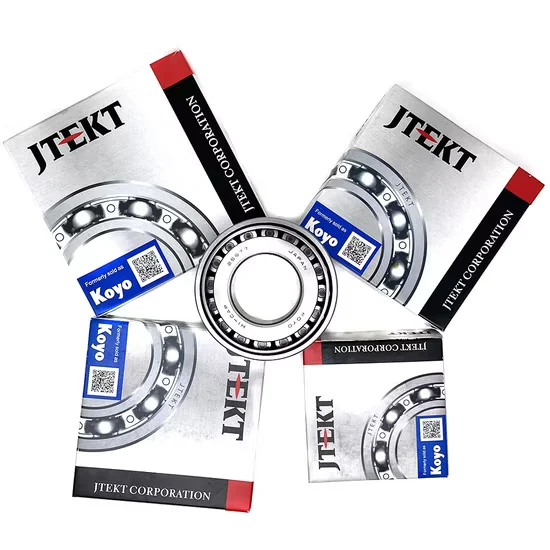
Tapered Roller Bearings
Koyo Tapered Roller Bearing 30203 30204 30205 30206 30207 for Auto Parts Wholesale
View Product
Inch Size Bearings
Koyo L420449/L420410 TRA181504 Tapered Roller Bearing for Auto Parts
View ProductKeep reading
More bearing selection guides for repair shops
Practical guides from KOYO Bearing Supplier on identifying Koyo / JTEKT bearings for farm machinery, construction equipment and power transmission repairs.
 Technical Resources
· 7 min read
Auto Bearing Glossary: Wholesale Supplier for Bulk & MRO Parts
Master the auto bearing glossary to decode suffix codes and prevent costly MRO replacement failures. Identical dimensions do not guarantee interchangeability, as internal clearance…
Read the Guide Technical Resources
· 8 min read
Needle Bearing Fit & Tolerance Table: Wholesale Supplier for Bulk Orders
Master the needle bearing fit and tolerance table to prevent seizure caused by overly tight fits. Match ISO shaft and housing classes while verifying…
Read the Guide Technical Resources · 7 min read
Auto Bearing Torque Reference Table Wholesale Supplier
Prevent premature bearing failures by strictly following the Auto Bearing Torque Reference Table instead of relying on subjective manual tightening. Learn to distinguish initial…
Read the Guide
Bearing enquiry
Send your machine details. Get a written Koyo / JTEKT quote.
KOYO Bearing Supplier quotes a single bearing position or every bearing in an assembly on one enquiry, matched to your machine model and application, with model, quantity, price, lead time and quote validity in writing.
- WhatsApp+1 (702) 981-5880
- Emailinfo@koyoome.com
- Address8 Research Drive, Greenville, SC 20627, USA
"When a Koyo bearing failed on a harvest machine during the season, we needed a replacement urgently. The supplier identified the correct Koyo reference, shipped same-day, and the machine was back in the field within the day."

Request a Bearing Quote
Tell us the machine and the bearing position. Photos of the markings can follow on WhatsApp.