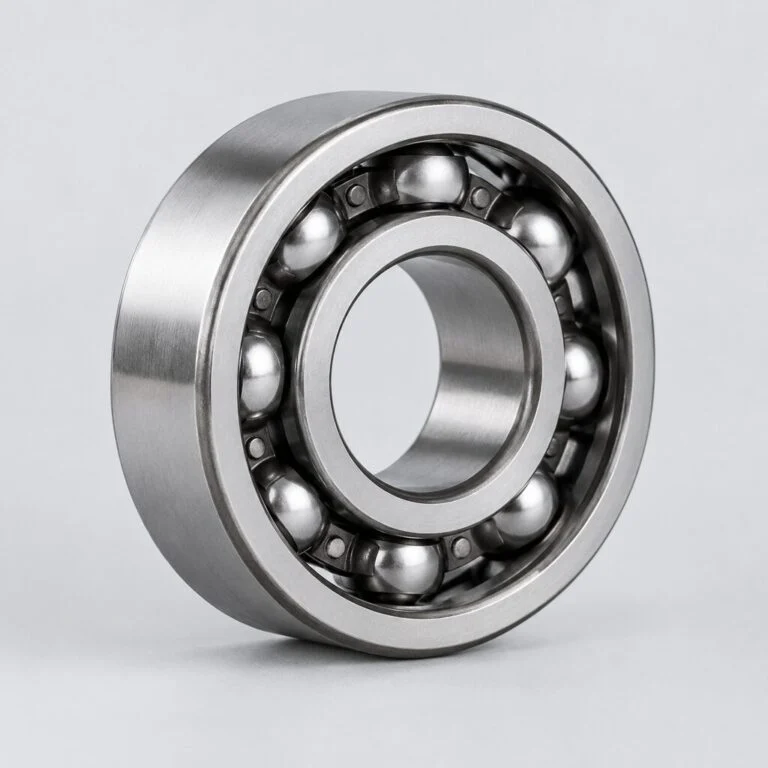
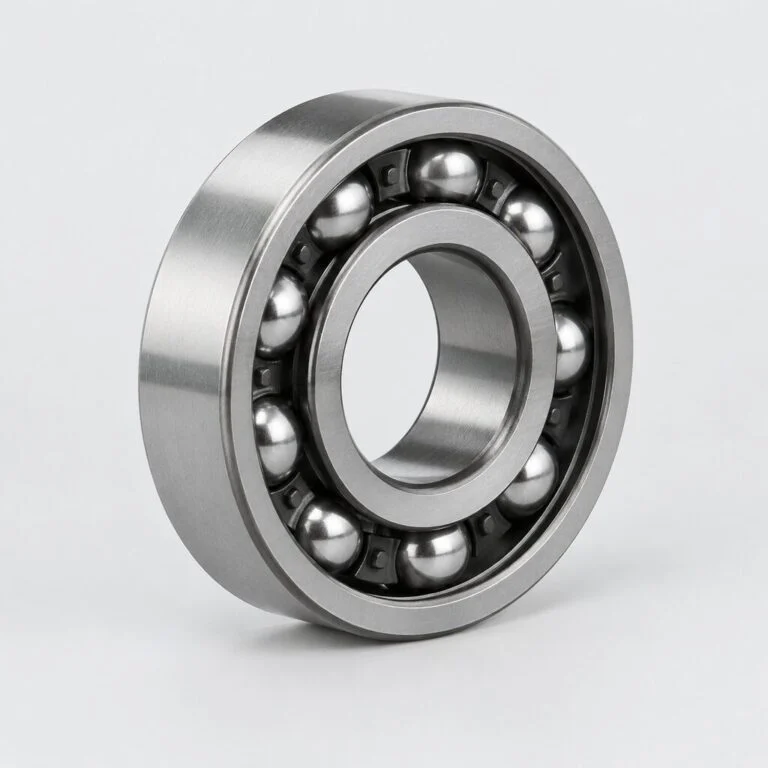
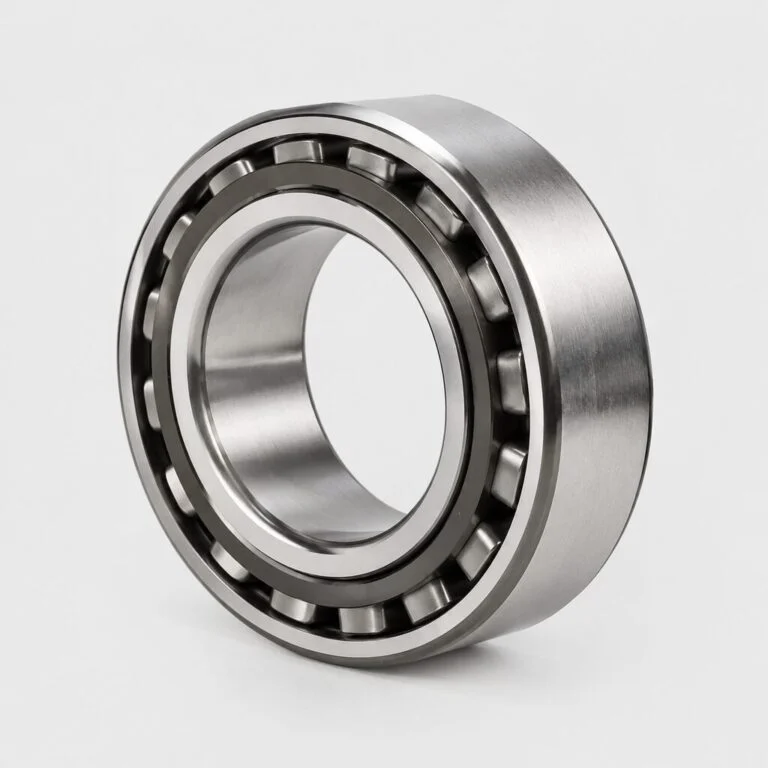
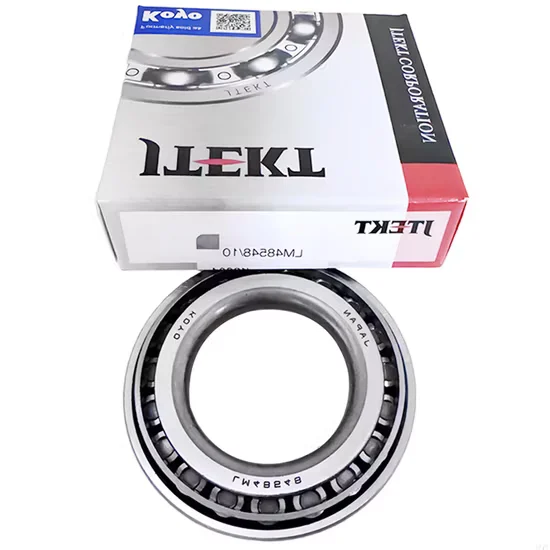
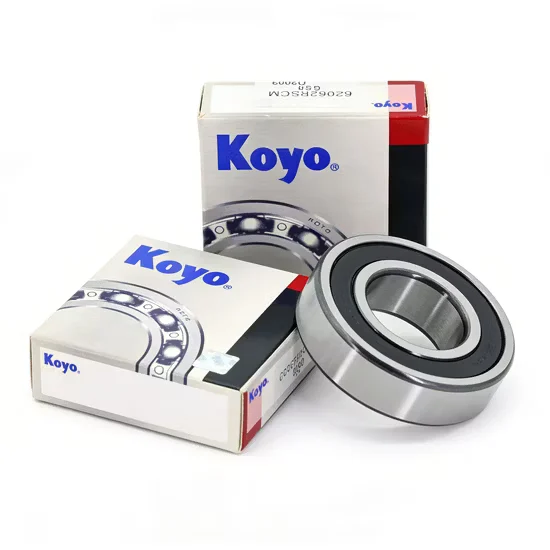
Mixed-Brand Sourcing Unified — Consolidate KOYO and other premium lines into single container shipments without juggling multiple vendors.
Technical Specifications
| Parameter | Value |
| Designation | KOYO 6810 |
| Bearing Type | Deep Groove Ball Bearing |
| Bore Diameter (d) | 50 mm |
| Outside Diameter (D) | 65 mm |
| Width (B) | 7 mm |
| Seal or Shield Type | Zz, 2RS, Open |
| Lubrication | Grease or Oil |
| Precision Class | P0, P6, P5, P4 |
| Vibration | Z1V1, Z2V2, Z3V3 |
| Material | Bearing Steel |
| Contact Angle | 0° |
| Arrangement | Non-Aligning Bearing |
| Number of Rows | Single |
| Load Direction | Radial Bearing |
| Origin | Japan |
Note: Specific suffixes like Zz, 2RS, and DDU require manufacturer catalog confirmation for exact sealing dimensions.
Application Suitability
| Industry | Typical Applications |
| Electric Motors | Rotor shaft support, cooling fan assemblies |
| Pumps | Impeller shaft radial support, seal chamber backing |
| Machine Tools | Spindle auxiliary drives, coolant pump motors |
Why Seal Suffix Errors Destroy KOYO 6810 Deep Groove Ball Bearing Lifespans
Matching the exact seal code to the moisture level prevents rapid rust-induced seizure.
I spent years on the grinding floor in Suzhou, watching perfectly machined components fail simply because the shielding couldn't handle the ambient humidity. When an electric motor client accidentally swapped a rubber-sealed variant for a metal-shielded one in a damp environment, the iron shields failed to block the moisture, leading to rapid rust and seizure. Sourcing the correct KOYO 6810 deep groove ball bearing requires strict attention to these suffix details to avoid such catastrophic downtime. Many procurement teams overlook the subtle differences in enclosure codes, assuming all variants offer identical protection. This assumption leads to severe operational disruptions when the wrong configuration is deployed in high-humidity pump rooms or washdown areas.

Aligning Shield and Seal Configurations with Motor Environments
Selecting the right enclosure for a KOYO 6810 deep groove ball bearing dictates its survival in electric motors and pumps. Our technical team cross-references your specific contamination risks against available shield and seal options, ensuring the chosen configuration handles the exact moisture and dust levels of your facility. This precise matching eliminates the guesswork that often leads to early replacements. We frequently see maintenance crews replacing the same motor bearings repeatedly because the initial selection ignored the ambient washdown protocols. By evaluating the actual environmental exposure rather than relying on generic catalog assumptions, we ensure the selected enclosure provides reliable, long-term protection without introducing excessive friction or thermal buildup.
Navigating Radial Loads and Contamination in Continuous Duty
Deep groove configurations excel at handling radial loads, but continuous operation in pumps and gearboxes introduces severe contamination risks. The choice between grease and oil lubrication must align with the operational speed and thermal dissipation needs of the equipment. Furthermore, non-contact metal shields minimize friction but offer limited protection against liquid ingress, whereas contact seals provide superior exclusion at the cost of slightly higher operating temperatures. Proper installation alignment is equally critical to prevent edge loading on the non-aligning raceways. When operators ignore these thermal and friction trade-offs, the internal lubricant degrades rapidly, leaving the rolling elements unprotected. Understanding the specific duty cycle and environmental exposure allows engineers to balance the need for contamination exclusion with the thermal limits of the chosen lubrication strategy.
Decoding Precision, Vibration, and Material Specifications
The 50x65x7 mm dimensions define the physical envelope, but the internal specifications dictate performance. Available precision classes ranging from P0 to P4 allow buyers to match the rotational accuracy required for sensitive machine tool spindles or standard household appliances. Vibration grades like Z1V1 up to Z3V3 are essential for quiet operation in electric motors, reducing acoustic noise and structural resonance. Available bearing steel options provide the necessary hardness and fatigue resistance for radial loads, while the single-row, non-aligning arrangement demands precise shaft and housing tolerances to avoid misalignment stresses. Ignoring vibration specifications in high-speed applications often results in unacceptable noise levels and accelerated fatigue, making it crucial to align these internal grades with the acoustic and dynamic requirements of the final assembly.
The Operational Toll of Misaligned Specifications
Specifying an incorrect precision class or ignoring vibration limits leads to unplanned downtime and accelerated wear in high-speed applications. When a standard clearance is forced into an application requiring thermal expansion compensation, the resulting internal preload causes catastrophic damage to the raceways. Such premature failures not only void warranties but also trigger costly secondary damage to adjacent pump or motor components, emphasizing the need for rigorous specification alignment. Maintenance budgets are quickly consumed when teams treat these components as interchangeable commodities rather than highly engineered precision parts. The hidden costs of wrong selections manifest in lost production hours, emergency freight charges for replacements, and the labor required to dismantle and rebuild complex gearboxes or motor assemblies.
Securing Authentic Components Through Verified Channels
Procuring genuine components means eliminating the risk of counterfeit steel that fails under basic radial loads. We verify authorized channel procurement and original factory batch traceability for every order, ensuring the metallurgical integrity of the selected steel variants. Our team actively prevents the common mistake of substituting metal shields for rubber seals in humid environments when sourcing a KOYO 6810 deep groove ball bearing by rigorously checking suffix codes against your application data. Additionally, we provide cross-brand equivalent model consultation when urgent maintenance requires immediate alternatives without compromising fitment. Buyers often face severe supply chain bottlenecks, and having a reliable partner who can validate technical equivalencies ensures that production lines keep moving without sacrificing quality or risking unexpected failures on the factory floor.
Documentation & Authenticity
- Original factory batch traceability linking the KOYO 6810 to its specific production run.
- Official brand app QR verification to confirm authenticity before installation.
- Material inspection reports validating the selected steel variants composition and heat treatment.
- Dimensional and running accuracy inspection confirming P4 or P6 tolerances prior to dispatch.
- Certificate of Conformity documenting the Japanese origin and manufacturing standards.
Storage, Handling & Mounting
- Retain original moisture-barrier packaging until mounting to protect selected steel variants from ambient humidity.
- Use clean, lint-free gloves when handling open variants to prevent sweat-induced corrosion on the 50 mm bore.
- Employ induction heating for the inner ring rather than direct flame to preserve precision class stability.
- Verify shaft tolerances strictly, as the non-aligning single-row design cannot compensate for misalignment during press-fitting.
- Maintain factory-applied grease integrity in sealed variants by avoiding unnecessary washing or relubrication attempts.
Engineering Data Required for Technical Validation
To ensure the selected configuration meets your operational demands, please provide the specific radial and axial loads, rotational speeds, and ambient temperature ranges. Sharing the OEM equipment model numbers allows our engineering team to perform accurate cross-reference checks and verify L10 life calculations. Detailing the exposure to moisture or particulate matter helps us recommend the exact seal or shield type needed for your application. Supplying comprehensive operational data transforms the procurement process from a simple transaction into a collaborative engineering exercise, ensuring that every component delivered is optimized for your specific mechanical and environmental challenges.
Frequently Asked Questions
Q: How can I verify the authenticity of the received bearings?
A: You can verify authenticity by scanning the QR codes on the packaging using the official brand application, which cross-references the batch number with the manufacturer's database. We also supply original factory batch traceability documents and material inspection reports, ensuring every component is fully traceable back to its authorized production facility and meets genuine quality standards.
Q: What are the differences between the available seal and shield types?
A: Metal shields provide low-friction protection against large dust particles but cannot block liquid moisture, making them unsuitable for damp environments. Rubber contact seals offer superior exclusion of water and fine contaminants, though they generate slightly more friction and heat. Selecting the correct type depends entirely on the specific contamination and temperature profile of your electric motor or pump application.
Q: How do I select the appropriate precision class for my motor?
A: Standard precision classes are sufficient for general industrial motors and conveyors where extreme rotational accuracy is not critical. However, high-speed spindles or sensitive machine tool applications require higher precision grades to minimize vibration and acoustic noise. Providing your exact operational speed and vibration tolerance limits allows our technical team to recommend the optimal grade for your equipment.
Q: What information is needed to determine the correct lubrication interval?
A: Determining the correct re-lubrication interval for grease-filled, open variants requires details on your operating speed, ambient temperature, and continuous duty cycle. High speeds and elevated temperatures accelerate grease degradation, necessitating shorter intervals. Share your specific operational parameters so we can calculate the appropriate maintenance schedule to prevent lubrication starvation and subsequent raceway damage.
Q: How should non-aligning bearings be installed to avoid damage?
A: Since non-aligning single-row designs cannot compensate for angular misalignment, the shaft and housing seats must be machined to strict tolerances. During installation, apply force only to the ring being press-fitted to prevent transmitting load through the rolling elements. Using induction heating for the inner ring ensures uniform expansion without compromising the dimensional stability or precision class of the component.