
Toyota HiAce Van Bearings: Genuine OEM & Bulk Wholesale Supplier
Cheap aftermarket bearings do not save money; they multiply it.
For fleet managers and repair groups sourcing Toyota HiAce van bearings, the only reliable path to minimizing downtime is securing genuine, fully traceable OEM components. Substandard alternatives often lack the precise heat treatment and material purity required for commercial loads, leading to premature hub disintegration that costs far more in lost revenue and compensation claims than the initial parts savings.
I still remember the silence in the dispatch office after a batch of budget bearings failed across a regional delivery fleet. The savings on the purchase order looked impressive on paper, but the reality was a string of vehicles stranded with seized hubs. The noise started as a low hum, then escalated to a grinding roar before the wheels locked up. That incident shifted my entire approach to procurement. I stopped looking at unit price and started looking at total cost of ownership. Now, when I evaluate Toyota HiAce van bearings, I demand documentation that proves origin and quality, not just a box with a logo.
The market is flooded with options that look identical but perform drastically differently under load. Understanding why these failures happen and how to verify authenticity is critical for anyone responsible for keeping commercial vans on the road. This guide breaks down the technical realities of hub failure, the hidden costs of cheap replacements, and the verification steps necessary for bulk sourcing.
Why Do Toyota HiAce Hub Bearings Fail Prematurely?
Material integrity and heat treatment define bearing life, not just dimensions.
A bearing that fits perfectly can still fail catastrophically if the steel lacks the necessary toughness. In high-mileage commercial applications like the HiAce, the front hubs endure significant lateral forces during cornering and heavy braking. Cheap alternatives often use lower-grade steel with inconsistent carbon content or skip critical deep-freeze stabilization processes.
When I inspect failed units from budget suppliers, the damage is rarely uniform. Instead of smooth wear patterns, I see spalling and micro-cracking on the raceways. This indicates that the material could not handle the cyclic stress. The heat treatment process, which hardens the surface while keeping the core tough, is frequently rushed or skipped entirely to cut costs. Without this balance, the bearing becomes brittle. Under the heavy load of a fully loaded van, microscopic cracks form and propagate rapidly, leading to sudden seizure.
Another common issue is poor sealing. Genuine OEM seals are designed to keep contaminants out while retaining grease under high temperatures. Counterfeit or low-quality substitutes often use rubber compounds that degrade quickly when exposed to road heat and brake dust. Once moisture enters the assembly, corrosion sets in, accelerating wear exponentially.
The result is not just a noisy wheel. It is a complete hub failure that can damage the axle shaft and steering knuckle. For a fleet operator, this means taking a vehicle off the road for days instead of hours. The initial saving of a few dollars per bearing is erased instantly by the cost of towing, additional parts, and labor. Sourcing Toyota HiAce van bearings requires looking beyond the box to the manufacturing standards behind the part.
What Are the Hidden Costs of Non-OEM Fleet Replacements?
Unplanned downtime costs significantly more than the price difference of premium parts.
Many procurement managers focus on the invoice total, ignoring the operational ripple effects of component failure. When a bearing fails prematurely, the cost is not limited to the replacement part. It includes the tow truck, the mechanic’s overtime, the rental vehicle for the driver, and the lost revenue from missed deliveries. In severe cases, it involves liability claims if the failure causes an accident.
I once worked with a logistics group that switched to a cheaper supplier to meet quarterly budget targets. Within months, their maintenance costs spiked. The bearings were failing at less than half the expected mileage. Each failure required a full hub assembly replacement because the damage had spread to the mating surfaces. The labor hours alone exceeded the annual savings they had projected. Worse, their reputation suffered as clients experienced delayed shipments.
The financial impact extends to warranty claims. Non-OEM parts rarely come with robust warranty support. When a failure occurs, the supplier often blames installation error or road conditions, leaving the fleet operator to absorb the cost. Genuine OEM components, backed by proper traceability, offer clear recourse. If a defect is found, the manufacturer stands behind the product. This security is invaluable for large fleets where consistency is key.
Furthermore, mixed-batch sourcing of unreliable parts creates inventory chaos. Workshops end up stocking multiple brands to cover failures, increasing administrative overhead and storage costs. By standardizing on verified Toyota HiAce van bearings, fleets simplify their supply chain and reduce the risk of installing the wrong component. The predictability of genuine parts allows for better maintenance scheduling and budget forecasting.
How to Verify Bearing Authenticity Before Bulk Sourcing?
Traceability documentation is the only proof of genuine OEM quality.
In the global aftermarket, counterfeits are sophisticated. They replicate packaging, logos, and even holograms. Visual inspection alone is no longer sufficient. The only reliable way to ensure authenticity is through complete traceability. This means every batch of bearings should come with documentation linking it back to the original manufacturer’s production records.
When I source Toyota HiAce van bearings for clients, I require certificates of conformity that include batch numbers, material test reports, and heat treatment logs. These documents prove that the parts were made in authorized facilities using approved materials. Suppliers who cannot provide this level of detail are likely selling gray-market or counterfeit goods. Full traceability also speeds up customs clearance and simplifies warranty claims, as authorities and manufacturers can verify the product’s origin instantly.
Another critical check is the supplier’s quality assurance system. Look for partners who operate under ISO-compliant quality management systems. This ensures that their storage, handling, and shipping processes prevent contamination and damage. A reputable supplier will also offer technical support, helping you cross-reference part numbers and verify compatibility across different HiAce models.
Be wary of prices that seem too good to be true. Genuine OEM bearings have a consistent market value based on raw material and manufacturing costs. Significant discounts usually indicate compromised quality. I always recommend requesting samples for independent testing before placing large orders. Check the weight, finish, and rotation smoothness. Compare them against known genuine units. Any deviation in feel or appearance is a red flag. Trusting verified documentation over price tags is the safest strategy for bulk procurement.
How to Optimize Mixed-Batch Sourcing for Repair Workshops?
Consolidation services reduce logistics complexity and improve availability.
Repair workshops often need a variety of bearing types for different HiAce variants and other commercial vehicles. Ordering each part from separate suppliers leads to high shipping costs and complex inventory management. A better approach is to use a one-stop consolidation service that stocks genuine multi-brand inventory. This allows workshops to mix SKUs in a single shipment, reducing freight expenses and lead times.
I have seen workshops struggle with stockouts of critical items because they relied on single-brand distributors. By partnering with a supplier that carries a broad range of premium brands like SKF, NSK, and KOYO, they gain flexibility. If one brand is unavailable, they can switch to an equivalent genuine alternative without compromising quality. This redundancy ensures that vehicles stay on the road even during supply chain disruptions.
Flexible minimum order quantities are also essential. Workshops do not always need container loads. They need the ability to order small batches for urgent repairs while maintaining the option to scale up for larger contracts. A supplier that accommodates both emergency spare-part orders and bulk consolidations provides the agility needed in today’s fast-paced market.
Technical support plays a huge role here. A good supplier helps identify cross-brand equivalents, ensuring that the right part is selected for each application. This reduces the risk of returns and rework. For Toyota HiAce van bearings, this means having access to detailed dimensional data and load ratings for various models. By leveraging these resources, workshops can optimize their inventory, reduce waste, and improve customer satisfaction.
Conclusion
Genuine traceability protects your fleet’s bottom line.
Sourcing Toyota HiAce van bearings is not just about buying a part; it is about investing in reliability. Cheap alternatives may lower upfront costs but inevitably lead to higher total expenses through downtime and secondary damage. By prioritizing full traceability, verifying documentation, and using consolidation services, fleet operators and workshops can ensure consistent performance and minimize risk. Choose quality that you can prove, not just price that you can see.
Mentioned in this article
Koyo / JTEKT bearings from this guide
These are the Koyo / JTEKT bearing types discussed above. Open any product to check its details, or quote it together with the rest of your repair.
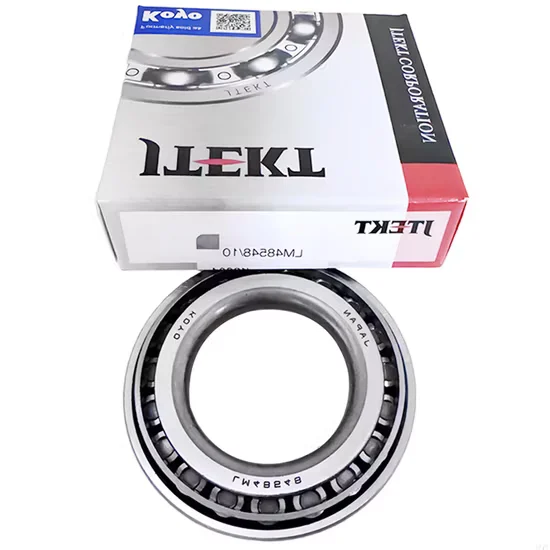
Tapered Roller Bearings
Genuine KOYO 32007 Tapered Roller Bearing Wholesale Supplier
View Product
Tapered Roller Bearings
Genuine KOYO 32006 Taper Roller Bearing Wholesale Supplier
View Product
Cylindrical Roller Bearings
Koyo NSK N408e Cylindrical Roller Bearing Genuine Wholesale Supplier
View Product
Cylindrical Roller Bearings
Koyo N2305e Cylindrical Roller Bearing Genuine Wholesale Supplier
View ProductKeep reading
More bearing selection guides for repair shops
Practical guides from KOYO Bearing Supplier on identifying Koyo / JTEKT bearings for farm machinery, construction equipment and power transmission repairs.
Applications & Industries · 8 min read
Small Engine Crankshaft Bearings Wholesale Supplier
Selecting the correct Bearings in Small Engine Crankshafts requires strict clearance matching and material verification rather than simple part number lookup. Standard units often…
Read the Guide Applications & Industries · 7 min read
Forklift Mast Bearings Wholesale Supplier | Genuine SKF FAG NSK Bulk
Selecting forklift mast bearings requires matching groove profiles and clearances to harsh environments to prevent premature seizure. Sourcing only genuine SKF, FAG, and NSK…
Read the Guide Applications & Industries · 6 min read
Outboard Lower Unit Bearings Wholesale Supplier
Prevent catastrophic gearcase failures by selecting Bearings in Outboard Lower Units that balance high-speed load capacity with strict corrosion resistance. Learn why standard tapered…
Read the Guide
Bearing enquiry
Send your machine details. Get a written Koyo / JTEKT quote.
KOYO Bearing Supplier quotes a single bearing position or every bearing in an assembly on one enquiry, matched to your machine model and application, with model, quantity, price, lead time and quote validity in writing.
- WhatsApp+1 (702) 981-5880
- Emailinfo@koyoome.com
- Address8 Research Drive, Greenville, SC 20627, USA
"When a Koyo bearing failed on a harvest machine during the season, we needed a replacement urgently. The supplier identified the correct Koyo reference, shipped same-day, and the machine was back in the field within the day."

Request a Bearing Quote
Tell us the machine and the bearing position. Photos of the markings can follow on WhatsApp.