
Outboard Lower Unit Bearings Wholesale Supplier
Standard tapered rollers are not enough for marine gearcases.
Selecting the right bearings for outboard lower units requires balancing high-speed load capacity with strict corrosion resistance to prevent catastrophic gearcase failures in marine environments. The primary failure mode is not mechanical fatigue from load, but chemical degradation and cage fragmentation caused by water ingress through inadequate sealing.
The transition from land-based industrial applications to marine propulsion reveals a harsh reality: water is omnipresent. In my early days handling after-sales support at the Beilun Port in Ningbo, I witnessed the consequences of overlooking this environmental factor. A batch of standard cone rollers sent to a Southeast Asian repair workshop failed within months. The keepers shattered, and the clients returned rusted clusters of metal, claiming compensation. This incident shifted my focus from mere part matching to rigorous condition analysis and authentic traceability. For any Outboard Lower Unit Bearings Wholesale Supplier, understanding that the marine environment demands more than just dimensional accuracy is the first step toward reliability.
What Are the Specific Operating Conditions in an Outboard Lower Unit?
High RPM, shock loads, and constant exposure to water and temperature shifts demand specialized bearing specs.
The lower unit of an outboard motor is arguably the most stressed component in the propulsion system. It operates submerged, often in turbulent water, transmitting engine power through a series of gears to the propeller. The bearings within this assembly must withstand radial and axial loads simultaneously, particularly during sharp turns or when shifting between forward and reverse gears under load.
Unlike stationary industrial machinery, outboard motors face dynamic thermal cycling. The gearcase heats up rapidly during operation and cools down quickly when the vessel is idle or moving at low speeds. This expansion and contraction can compromise seal integrity if the bearing housing and shaft tolerances are not perfectly matched. Furthermore, the presence of saltwater accelerates galvanic corrosion, attacking not just the rolling elements but also the cages and seals.
A common misconception is that any high-quality tapered roller bearing will suffice. However, marine-grade applications require specific attention to cage material. Standard steel cages may corrode rapidly if water penetrates the seal, leading to disintegration. Brass or polymer cages offer better resistance but must be compatible with marine gear oils.
For an Outboard Lower Unit Bearings Wholesale Supplier, recognizing these operational nuances is critical. It is not merely about supplying a part number; it is about ensuring the component can survive the unique synergy of hydrodynamic pressure, mechanical shock, and chemical attack.
Why Do Standard Bearings Fail Prematurely in Marine Gearcases?
Inadequate sealing leads to water ingress, destroying cages and causing rapid corrosion.
Most assume standard tapered rollers suffice; the true cause of failure is lack of specialized marine sealing and corrosion-resistant cages. When water enters the gearcase, it mixes with the lubricant, forming an emulsion that loses its protective properties. This leads to micro-pitting on the raceways and eventual spalling. More critically, the water attacks the bearing cage. In the case I encountered in Southeast Asia, the cage fragmentation was the immediate cause of seizure, not the rolling elements themselves.
Many think cheaper aftermarket bearings save costs; the true reality is that water ingress causes exponential downtime and gearcase replacement costs. A failed bearing often damages the housing, gears, and seals, turning a minor maintenance job into a major overhaul.
| Failure Mode | Standard Industrial Bearing | Marine-Grade Specified Bearing |
|---|---|---|
| Seal Integrity | Basic rubber lip, prone to hardening | Reinforced fluorocarbon or multi-lip designs |
| Cage Material | Standard steel, vulnerable to rust | Corrosion-resistant brass or engineered polymer |
| Lubrication Compatibility | General purpose grease/oil | Formulated for water-contaminated marine gear oil |
| Corrosion Resistance | Limited, relies on external coating | Integrated material resistance and surface treatment |
The table above highlights the qualitative differences that define longevity in marine applications. An Outboard Lower Unit Bearings Wholesale Supplier must verify that the products offered meet these enhanced criteria, rather than simply repackaging industrial stock.
How to Select the Right Bearing Types for Lower Units?
Matching tapered and deep groove ball bearings with proper marine-grade seals and cage materials.
Selection involves a careful balance of type and specification. Tapered roller bearings are typically used for handling the heavy thrust loads generated by the propeller, while deep groove ball bearings may support radial loads in specific configurations. The key is not just the type, but the precision class and internal clearance. Marine applications often benefit from C3 clearance to accommodate thermal expansion, but this must be verified against the manufacturer’s design specifications.
High-performance marine OEMs are increasingly upgrading to sealed precision bearings for heavy-load shifting. This trend reflects a need for higher load capacity ratios and extended lifespan. For MRO operators, replicating this level of performance requires sourcing components that match the original equipment manufacturer’s intent, not just its dimensions.
When selecting bearings, consider the following steps:
- Verify the load rating against the engine’s power output and propeller size.
- Confirm the seal material is compatible with the specific marine gear oil used.
- Ensure the cage material is resistant to corrosion in saltwater environments.
- Check for genuine origin and traceability to avoid counterfeit-induced failures.
An experienced Outboard Lower Unit Bearings Wholesale Supplier will provide technical selection support to ensure these parameters are met. This goes beyond providing a catalog; it involves understanding the specific vessel’s operating profile and recommending the most suitable component variant.
What Should Buyers Verify When Sourcing Marine Bearings?
Traceability, genuine origin, and technical support are critical to avoid counterfeit-induced failures.
Sourcing marine bearings is fraught with risk due to the prevalence of counterfeit products. These fake bearings may look identical to genuine ones but lack the material purity and precision manufacturing required for marine duties. They often fail prematurely, leading to costly repairs and potential safety hazards.
Global MRO distributors often face the challenge of sourcing mixed-brand marine bearing kits for urgent vessel overhauls. The priority here is lead time reduction and batch consistency. A reliable supplier must have a robust inventory management system that ensures every part is traceable to its original manufacturer. This includes providing documentation such as certificates of conformity and material test reports.
In my current role, I emphasize the importance of verifying the supply chain. We maintain a genuine multi-brand marine bearing inventory, ensuring that every item, whether from SKF, FAG, NSK, or TIMKEN, is sourced through authorized channels. This approach minimizes the risk of introducing substandard components into critical marine systems.
Buyers should ask for:
- Proof of origin for each batch.
- Technical datasheets confirming material specifications.
- Access to engineering support for complex selection queries.
An Outboard Lower Unit Bearings Wholesale Supplier who cannot provide these verifications poses a significant risk to your operations. The cost savings from unverified sources are negligible compared to the potential loss of a vessel’s propulsion system.
Conclusion
Choosing the correct bearing is a safeguard against catastrophic marine failure.
The harsh marine environment demands bearings that offer more than just mechanical strength; they require superior corrosion resistance and sealing integrity. By understanding the specific operating conditions and verifying the authenticity of components, operators can ensure the longevity and reliability of their outboard lower units. Partnering with a knowledgeable Outboard Lower Unit Bearings Wholesale Supplier provides the technical expertise and genuine products necessary to navigate these challenges effectively.
Mentioned in this article
Koyo / JTEKT bearings from this guide
These are the Koyo / JTEKT bearing types discussed above. Open any product to check its details, or quote it together with the rest of your repair.
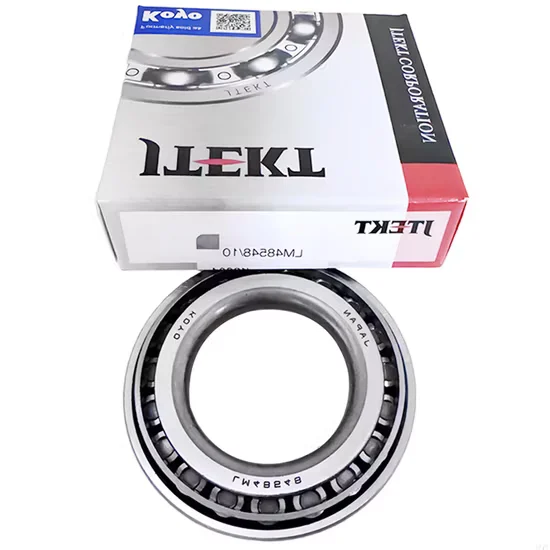
Tapered Roller Bearings
Genuine KOYO 32007 Tapered Roller Bearing Wholesale Supplier
View Product
Tapered Roller Bearings
Genuine KOYO 32006 Taper Roller Bearing Wholesale Supplier
View Product
Cylindrical Roller Bearings
Koyo NSK N408e Cylindrical Roller Bearing Genuine Wholesale Supplier
View Product
Cylindrical Roller Bearings
Koyo N2305e Cylindrical Roller Bearing Genuine Wholesale Supplier
View ProductKeep reading
More bearing selection guides for repair shops
Practical guides from KOYO Bearing Supplier on identifying Koyo / JTEKT bearings for farm machinery, construction equipment and power transmission repairs.
Applications & Industries · 8 min read
Small Engine Crankshaft Bearings Wholesale Supplier
Selecting the correct Bearings in Small Engine Crankshafts requires strict clearance matching and material verification rather than simple part number lookup. Standard units often…
Read the Guide Applications & Industries · 7 min read
Forklift Mast Bearings Wholesale Supplier | Genuine SKF FAG NSK Bulk
Selecting forklift mast bearings requires matching groove profiles and clearances to harsh environments to prevent premature seizure. Sourcing only genuine SKF, FAG, and NSK…
Read the Guide Applications & Industries
· 8 min read
Camshaft Drive Bearings: Genuine SKF, FAG, INA Wholesale Supplier
Prevent catastrophic engine seizures by sourcing genuine camshaft drive bearings with full traceability. Learn to identify counterfeit risks through customs declarations and verify authenticity…
Read the Guide
Bearing enquiry
Send your machine details. Get a written Koyo / JTEKT quote.
KOYO Bearing Supplier quotes a single bearing position or every bearing in an assembly on one enquiry, matched to your machine model and application, with model, quantity, price, lead time and quote validity in writing.
- WhatsApp+1 (702) 981-5880
- Emailinfo@koyoome.com
- Address8 Research Drive, Greenville, SC 20627, USA
"When a Koyo bearing failed on a harvest machine during the season, we needed a replacement urgently. The supplier identified the correct Koyo reference, shipped same-day, and the machine was back in the field within the day."

Request a Bearing Quote
Tell us the machine and the bearing position. Photos of the markings can follow on WhatsApp.