
Koyo vs Moog Hub Units: Genuine Wholesale Supplier for Bulk
Visual similarity does not guarantee direct interchangeability.
Koyo and Moog hub units share external dimensions but differ critically in ABS sensor tooth counts, flange bolt patterns, and internal clearance specifications. Buyers must verify exact OEM technical drawings rather than relying on visual inspection or cross-reference catalogs alone to prevent ABS system failures and premature bearing wear.
I learned this lesson the hard way during a shipment to a North American repair group. The order looked correct on paper. The part numbers matched the general application list. The units sat side by side in the warehouse, identical in weight and outer diameter. Yet, once installed, the vehicles triggered immediate ABS warnings. The issue was not a manufacturing defect but a specification mismatch. One brand used a 48-tooth encoder ring while the other required 59 teeth for the same vehicle platform. The entire container was returned. That incident shifted my focus from simple part number matching to deep parameter verification. Today, I treat every Koyo vs Moog hub units inquiry as a technical audit rather than a simple stock check.
What Are the Core Structural Differences Between Koyo and Moog?
Internal clearance and seal structures define service life under load.
While both brands produce high-quality components, their engineering philosophies diverge in how they handle internal geometry. Koyo, as part of the JTEKT group, often aligns its internal clearance standards closely with Japanese OEM specifications. Moog, with its strong presence in the North American and European aftermarket, frequently adapts its designs to accommodate broader vehicle variations and harsher road conditions.
The most critical difference lies in the internal radial and axial clearance. Selecting the wrong clearance for the operating environment leads to rapid failure. A unit designed for standard passenger car loads may fail prematurely when subjected to the heavy-duty cycles of commercial fleets. Conversely, a unit with excessive clearance intended for heavy loads may cause noise and vibration in light-duty applications.
| Feature | Koyo Typical Specification Approach | Moog Typical Specification Approach |
|---|---|---|
| Internal Clearance | Often adheres strictly to OEM JIS/ISO standards | Frequently adjusted for aftermarket durability |
| Seal Lip Material | Standard nitrile rubber for general use | Often uses enhanced compounds for moisture resistance |
| Grease Type | Standard lithium-based complex | High-temperature resistant formulations common |
| Flange Rigidity | Optimized for weight reduction | Reinforced for high-stress impact resistance |
A Middle East distributor once reported a high return rate for a specific SUV model. The parts looked genuine. The packaging was intact. However, the local driving conditions involved frequent high-speed travel on unpaved roads. The standard clearance units were experiencing early spalling. Switching to a variant with controlled tighter tolerance and enhanced seal protection reduced the return ratio noticeably. This highlights why understanding the Koyo vs Moog hub units structural nuances is vital for bulk buyers. You are not just buying a bearing; you are buying a specific engineering solution for a specific environment.
How Do ABS Sensor Specs Affect Fitment?
Mismatched tooth ring counts cause immediate dashboard errors.
The most frequent cause of returns in the automotive aftermarket is not bearing noise but electronic failure. Modern vehicles rely on precise signals from the ABS sensor ring integrated into the hub unit. Even a single tooth difference between the encoder ring and the vehicle’s sensor expectation will trigger a fault code.
Koyo and Moog may source their encoder rings from different suppliers or use different manufacturing processes. For some vehicle platforms, Koyo might use a magnetic encoder with a specific pole count, while Moog might use a tone ring with a different tooth geometry. These differences are invisible to the naked eye. You cannot count the teeth without disassembling the unit or having the technical datasheet.
Consider a case involving a European fleet operator. They ordered replacement hubs for a series of vans. The part numbers seemed compatible. Upon installation, half the vehicles displayed ABS warnings. The investigation revealed that the supplier had mixed batches. Some units had 48 teeth, others had 59. The vehicle’s ECU could not interpret the signal from the mismatched units. The cost of recalibrating the systems and replacing the units far exceeded the initial savings from choosing the cheaper option.
When evaluating Koyo vs Moog hub units, always request the ABS specification sheet. Verify the tooth count, the type of encoder (passive vs. active), and the air gap tolerance. Do not assume that a “direct fit” claim in a catalog guarantees electronic compatibility.
Which Brand Suits Specific Vehicle Applications?
OEM alignment dictates reliability for Asian versus Western fleets.
Choosing between these two brands often depends on the origin of the vehicle fleet you are servicing. Koyo has deep historical ties with Japanese and Korean automakers. If your clients primarily service Toyota, Honda, Nissan, or Hyundai vehicles, Koyo units often match the original equipment specifications more closely. This includes not just dimensions but also the specific grease types and seal materials used by the OEM.
Moog, on the other hand, has a strong reputation in the American and European markets. Their units are often engineered to meet or exceed the specifications of Ford, GM, Chrysler, Volkswagen, and BMW. In many cases, Moog units include design improvements over the original parts, such as reinforced flanges or upgraded seals, to address known weaknesses in the OEM design.
| Vehicle Origin | Recommended Brand Focus | Key Reason |
|---|---|---|
| Japanese/Korean | Koyo | Direct OEM supply chain alignment |
| American/European | Moog | Aftermarket enhancements for known OEM weaknesses |
| Mixed Fleet | Both | Requires strict part-by-part verification |
A large repair group in Southeast Asia struggled with inconsistent quality when servicing a mixed fleet of imported used cars. They found that using Koyo for Japanese imports and Moog for American imports reduced their warranty claims significantly. This strategic sourcing approach requires a supplier who can provide both brands with verified authenticity. Understanding the Koyo vs Moog hub units application matrix helps distributors stock the right inventory for their local market demographics.
How to Verify Authenticity and Specs Before Bulk Ordering?
Traceability documentation prevents costly fitment disasters.
The aftermarket is flooded with counterfeit products that mimic the packaging of major brands. A visually perfect box does not guarantee a genuine product. Counterfeit units often use inferior steel, lack proper heat treatment, and have incorrect internal clearances. These defects may not be apparent until the unit fails in service, leading to liability issues for the distributor.
To mitigate this risk, implement a strict verification protocol. First, demand traceability documents. Genuine products come with batch numbers that can be traced back to the manufacturing facility. Second, perform random sample inspections. Check the laser etching on the hub body. Counterfeit items often have shallow or misaligned markings. Third, verify the ABS sensor output if possible. Use a test bench to confirm the signal pattern matches the OEM specification.
I once inspected a batch of hubs that looked perfect. The packaging was flawless. However, the laser etching on the flange was slightly off-center. A quick check with a micrometer revealed that the bolt hole pattern was out of tolerance by a fraction of a millimeter. This small deviation would have caused installation difficulties and potential safety hazards. Rejecting that batch saved the client from a major recall.
When sourcing Koyo vs Moog hub units, work with a supplier who prioritizes transparency. Ask for proof of origin. Request technical datasheets for critical parameters. Do not hesitate to ask for sample units for testing before committing to a full container load. A reliable partner will welcome these questions as they demonstrate your commitment to quality.
Conclusion
Parameter verification outweighs visual inspection.
Selecting the right hub unit requires more than matching part numbers. It demands a thorough understanding of internal clearances, ABS specifications, and OEM alignments. Koyo and Moog both offer excellent products, but they serve different technical needs. By focusing on detailed specifications and verifying authenticity through traceable documentation, buyers can avoid costly returns and ensure vehicle safety. A disciplined approach to Koyo vs Moog hub units sourcing transforms potential risks into reliable inventory solutions.
Mentioned in this article
Koyo / JTEKT bearings from this guide
These are the Koyo / JTEKT bearing types discussed above. Open any product to check its details, or quote it together with the rest of your repair.
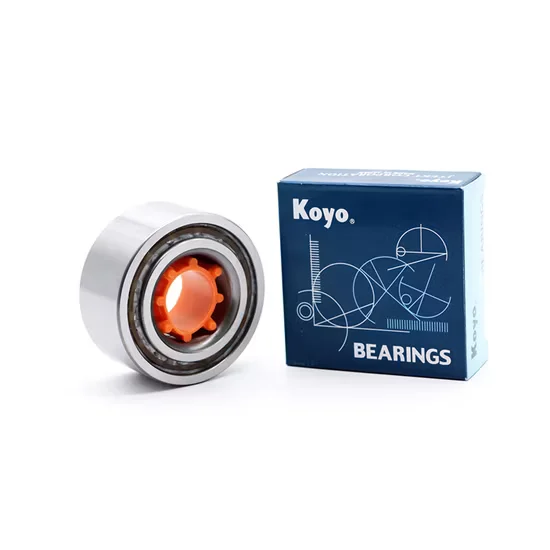
Cylindrical Roller Bearings
Koyo Bahb311316b Auto Wheel Bearing Drive Axle Hub Unit
View Product
Cylindrical Roller Bearings
Koyo NSK N408e Cylindrical Roller Bearing Genuine Wholesale Supplier
View Product
Cylindrical Roller Bearings
Koyo N2305e Cylindrical Roller Bearing Genuine Wholesale Supplier
View Product
Tapered Roller Bearings
BDL 30204 Tapered Roller Bearing Genuine Wholesale Supplier
View ProductKeep reading
More bearing selection guides for repair shops
Practical guides from KOYO Bearing Supplier on identifying Koyo / JTEKT bearings for farm machinery, construction equipment and power transmission repairs.
 Brands & Alternatives
· 7 min read
Koyo Automotive Bearings Wholesale Supplier for Global Bulk Orders
Master global sourcing of Koyo automotive bearings by solving mixed-brand customs risks and verifying authenticity beyond packaging. Learn to validate technical specs, select reliable…
Read the Guide Brands & Alternatives
· 6 min read
Premium vs Economy Motorcycle Bearings: Wholesale Supplier for Bulk Orders
Choosing between premium vs economy motorcycle bearings requires analyzing total cost of ownership rather than just upfront price. Economy options often fail under heavy…
Read the Guide Brands & Alternatives
· 8 min read
OE Koyo vs Aftermarket Box: Differences for Wholesale Buyers
Understand the critical OE Koyo vs Aftermarket Box differences to avoid severe customs delays and terminal rejections in strict markets. Original packaging features holographic…
Read the Guide
Bearing enquiry
Send your machine details. Get a written Koyo / JTEKT quote.
KOYO Bearing Supplier quotes a single bearing position or every bearing in an assembly on one enquiry, matched to your machine model and application, with model, quantity, price, lead time and quote validity in writing.
- WhatsApp+1 (702) 981-5880
- Emailinfo@koyoome.com
- Address8 Research Drive, Greenville, SC 20627, USA
"When a Koyo bearing failed on a harvest machine during the season, we needed a replacement urgently. The supplier identified the correct Koyo reference, shipped same-day, and the machine was back in the field within the day."

Request a Bearing Quote
Tell us the machine and the bearing position. Photos of the markings can follow on WhatsApp.