
Koyo Pilot Bearings Wholesale Supplier & Bulk Exporter
The lowest unit price often hides the highest total cost when customs clearance fails or freight claims are denied.
Sourcing genuine Koyo pilot bearings requires balancing precise dimensional matching with rigorous authenticity verification and high-density consolidation logistics to avoid hidden costs. Buyers must prioritize traceability documentation and weight-distribution planning over simple per-unit pricing to ensure successful delivery and operational reliability.
I still recall the silence in the office after a shipment of Koyo pilot bearings destined for Dubai got stuck at the port. The issue was not the quality of the steel or the precision of the grind, but a missing specification on the customs declaration regarding flange presence. Combined with a routine brand authenticity check, the cargo sat idle for half a month. The client, facing a production line stoppage, had to pay a premium for emergency air freight to replace the delayed stock. That incident shifted my focus from merely filling containers to scrutinizing every declaration element and packaging constraint.
This experience highlights that wholesale export is not just about stuffing goods into a box. For regional distributors and MRO operators, the pitfalls in logistics and verification often outweigh the challenges of technical selection.
How to Select the Right Koyo Pilot Bearing for Your Application?
Selection is not merely about matching inner and outer diameters; it is about verifying load capacity and tolerance classes against specific clutch assembly requirements.
A mismatch in dimensions, even by a fraction of a millimeter, can lead to premature failure in clutch systems. The primary function of a pilot bearing is to support the input shaft of the transmission, ensuring it remains aligned with the crankshaft. When sourcing Koyo pilot bearings, buyers must consult detailed dimensional matrices rather than relying on generic cross-reference charts that may overlook subtle design variations.
Consider a case where a distributor in Southeast Asia received a batch of bearings that fit physically but failed under load. The issue was a tolerance deviation that was within general industrial standards but exceeded the strict requirements of the specific automotive application. The resulting vibration caused early wear on the transmission input shaft. To prevent this, buyers should request technical datasheets that specify the radial play and load ratings.
| Selection Factor | Critical Checkpoint | Risk of Neglect |
|---|---|---|
| Inner Diameter | Match transmission input shaft exactly | Shaft scoring or loose fit |
| Outer Diameter | Verify press-fit tolerance in flywheel | Bearing spin-out or housing damage |
| Load Capacity | Confirm dynamic load rating for engine type | Premature fatigue failure |
| Material Grade | Ensure high-carbon chromium steel specification | Reduced durability under heat |
When evaluating Koyo pilot bearings, always cross-check the part number against the official JTEKT technical catalogs. Generic listings often group similar-looking bearings together, ignoring critical differences in seal types or lubrication methods. A verified supplier will provide these specific technical documents upon request, allowing you to validate the suitability before placing a bulk order.
How to Verify the Authenticity of Koyo Pilot Bearings?
Authenticity verification goes beyond checking the logo; it requires examining packaging integrity, surface finish, and traceability documentation.
The market for Koyo pilot bearings is flooded with counterfeits that mimic the appearance of genuine products but lack the metallurgical quality and precision engineering. These fakes often use lower-grade steel and improper heat treatment, leading to rapid failure under high temperatures and loads. For wholesalers, distributing counterfeit goods can damage reputation and lead to significant liability claims.
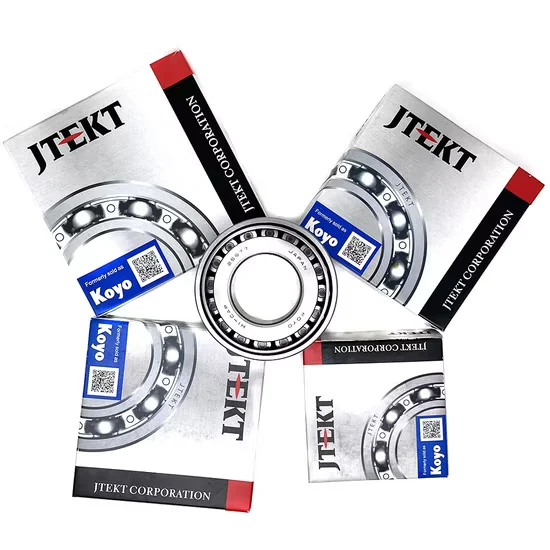
To verify authenticity, start with the packaging. Genuine Koyo products come in boxes with specific printing quality, barcodes, and holographic seals that are difficult to replicate. The bearings themselves should have a smooth, consistent surface finish with clear, laser-etched part numbers. Counterfeit units often have rough edges, inconsistent coloring, or stamped markings that appear uneven.
A European automotive supplier once reported a batch of bearings that looked correct but failed prematurely. Upon inspection, the internal grease was found to be of inferior quality, lacking the high-temperature stability required for clutch applications. This issue was only detectable through laboratory analysis, which is why sourcing from a supplier with complete traceability documentation is crucial. These documents link the batch to the manufacturer’s production records, providing proof of origin.
When importing Koyo pilot bearings, insist on certificates of origin and material test reports. A reliable supplier will maintain a digital archive of these documents for each batch, allowing you to verify the lineage of the parts. This level of transparency is a key differentiator between a trading company that simply moves boxes and a professional partner that ensures product integrity.
What Are the Critical Logistics Pitfalls When Importing Pilot Bearings?
High-density cargo like pilot bearings requires precise weight distribution and accurate customs declarations to prevent packaging damage and clearance delays.
Pilot bearings are small, heavy, and dense. When consolidated in a container, they can create localized high-weight zones that crush standard packaging if not properly palletized. I have seen cases where the bottom layers of a pallet were compressed into a solid block, rendering the bearings unusable due to damaged seals and races. This is not a manufacturing defect but a logistics failure.
To mitigate this, use reinforced packaging and limit the height of stacked boxes on pallets. Distribute the weight evenly across the pallet base and use shrink wrap to stabilize the load. Additionally, ensure that the gross weight declared on the bill of lading matches the actual weight precisely. Discrepancies can trigger inspections, leading to delays and additional fees.
Customs declarations must be detailed. As mentioned earlier, omitting specifications such as flange presence or material composition can cause holds. For Koyo pilot bearings, the declaration should include the full part number, country of origin, and intended use. This clarity helps customs officers process the shipment quickly, reducing the risk of storage demurrage charges.
Another common pitfall is inadequate insurance coverage. Standard freight insurance may not cover damage resulting from poor packing or handling. Ensure that your policy covers “all risks” and includes provisions for damage due to crushing or moisture. A professional consolidator will offer inspection services before shipment, verifying that the packaging meets international shipping standards.
Navigating the Global Supply Chain for Genuine Parts
Reliable sourcing depends on partners who understand both technical specifications and logistical complexities.
For regional distributors in the Middle East, Africa, and Latin America, accessing genuine Koyo pilot bearings at competitive prices is a constant challenge. Official brand channels often have high minimum order quantities and long lead times, while local markets are prone to counterfeits. Bridging this gap requires a supplier who can offer flexible MOQs, mixed-brand consolidation, and verified authenticity.
A mining operator in Central Asia faced repeated downtime due to failed pilot bearings in their heavy equipment fleet. By switching to a supplier who provided genuine Koyo parts with full traceability and optimized shipping consolidation, they reduced their inventory holding costs and improved equipment availability. The key was not just the product, but the reliability of the supply chain.
When selecting a partner, look for those who offer technical support and cross-reference consultation. They should be able to help you identify equivalent models from other premium brands if Koyo stock is unavailable, ensuring your operations continue without interruption. This level of service transforms a transactional relationship into a strategic partnership.
The ability to consolidate mixed orders allows buyers to optimize freight costs. Instead of ordering full containers of a single item, you can combine various bearing types and brands into one shipment. This flexibility is essential for MRO operators who need a wide range of spare parts for different machinery.
Conclusion
Sourcing Koyo pilot bearings successfully requires a holistic approach that integrates technical verification, authenticity checks, and logistical precision.
Buyers must look beyond unit price to consider the total cost of ownership, including risks of customs delays, freight damage, and operational failures. By prioritizing traceability, proper packaging, and detailed declarations, distributors and end-users can secure genuine parts and ensure smooth global delivery.
Mentioned in this article
Koyo / JTEKT bearings from this guide
These are the Koyo / JTEKT bearing types discussed above. Open any product to check its details, or quote it together with the rest of your repair.
Keep reading
More bearing selection guides for repair shops
Practical guides from KOYO Bearing Supplier on identifying Koyo / JTEKT bearings for farm machinery, construction equipment and power transmission repairs.
 Buying Guide
· 8 min read
Koyo Auto Bearings Wholesale Supplier & Bulk Quote
Request a Quote for Koyo Auto Bearings that accounts for total landed cost, not just FOB price. Optimize margins through mixed-container consolidation and ensure…
Read the Guide Buying Guide · 7 min read
Koyo Auto Bearings Wholesale Supplier for Parts Stores
Stocking Koyo auto bearings requires strict verification of suffix codes and traceability to prevent costly assembly failures. Learn essential packaging checks and cross-brand alternatives…
Read the Guide Buying Guide
· 7 min read
Fake Auto Bearings: Neutral Buyer Checks Wholesale Supplier
Master Fake Auto Bearings Neutral Buyer Checks by shifting focus from packaging to internal physical inspections and traceability. Detect counterfeits through acidic rust oil…
Read the Guide
Bearing enquiry
Send your machine details. Get a written Koyo / JTEKT quote.
KOYO Bearing Supplier quotes a single bearing position or every bearing in an assembly on one enquiry, matched to your machine model and application, with model, quantity, price, lead time and quote validity in writing.
- WhatsApp+1 (702) 981-5880
- Emailinfo@koyoome.com
- Address8 Research Drive, Greenville, SC 20627, USA
"When a Koyo bearing failed on a harvest machine during the season, we needed a replacement urgently. The supplier identified the correct Koyo reference, shipped same-day, and the machine was back in the field within the day."

Request a Bearing Quote
Tell us the machine and the bearing position. Photos of the markings can follow on WhatsApp.