
Genuine Bearings for Transfer Cases – Wholesale Supplier
Most transfer case failures are not caused by overload, but by incorrect internal clearance.
Selecting the right bearings for heavy equipment transfer cases requires matching dynamic load ratings and internal clearance to specific torque requirements, while sourcing genuine replacements with full traceability documentation to prevent catastrophic gear scattering.
I still remember the sound of a mining truck’s transfer case grinding to a halt in the dusty heat of Dongguan. It was a routine overhaul, or so I thought. The previous mechanic had installed what looked like perfect tapered roller bearings, sourced from a local supplier who promised “OEM quality” at a fraction of the price. The packaging was convincing, the metal shone, and the fit seemed tight. But less than two hundred hours into operation, the bearing cage disintegrated. The resulting debris didn’t just stop the vehicle; it shattered the main drive gears inside the casing. The repair bill ran into the mid-six figures, a cost that far exceeded any savings from the cheap parts. That failure wasn’t due to excessive load or poor driver habits. It was a fundamental mismatch in internal clearance, a detail invisible to the naked eye but critical to the survival of the gear train.
This experience shifted my entire approach to sourcing. In the world of heavy machinery, the transfer case is the heart of power distribution, and its bearings are the pulse. When that pulse falters, the entire machine stops. For MRO operators and distributors, understanding why these components fail and how to source authentic replacements is not just technical knowledge—it is financial survival.
Why Do Transfer Case Bearings Fail Prematurely?
Incorrect internal clearance and poor lubrication compatibility are the primary drivers of early bearing failure, not just external overload.
Many operators assume that if a bearing fails, the machine was pushed too hard. While overload is a factor, it is rarely the sole culprit in premature failures. The root cause often lies in the microscopic space between the rolling elements and the raceways, known as internal clearance. If this clearance is too tight, the bearing generates excessive heat under load, leading to thermal expansion that locks the rollers in place. If it is too loose, the impact loads from rough terrain cause micro-spalling on the raceways, eventually leading to fatigue failure.
In heavy equipment, transfer cases operate under fluctuating speeds and high torque. A standard automotive bearing might survive in a passenger car, but in a mining dump truck, the same design without adjusted clearance will fail rapidly. I have seen cases where the wrong grease was used, one that hardened at low temperatures or broke down under high shear stress, starving the bearing of lubrication. The result is always the same: metal-on-metal contact, rapid temperature rise, and catastrophic seizure.
Another common misconception is that visual inspection guarantees quality. A bearing can look perfect yet have subsurface defects from poor manufacturing processes. These defects only reveal themselves under stress, often after the equipment has been returned to service. This is why relying on brand reputation alone is insufficient without verifying the specific application parameters.
How to Select Bearings for Heavy-Duty Transfer Cases?
Match the dynamic load rating and internal clearance class to the specific torque and speed profile of the equipment.
Selection is not about picking the biggest or most expensive bearing. It is about precision matching. The first step is identifying the load conditions. Transfer cases in construction equipment face combined radial and axial loads, making tapered roller bearings the industry standard for their ability to handle these forces simultaneously.
When selecting a replacement, you must consider the operating environment. For instance, a wheel loader working in a quarry experiences different shock loads than a forestry harvester. The bearing’s dynamic load rating must exceed the maximum expected load with a sufficient safety margin. However, the static load rating is equally important for equipment that sits idle under load for extended periods.
Internal clearance is the second critical parameter. Standard clearance (C0) may work for general industrial applications, but heavy equipment often requires C3 or C4 clearance to accommodate thermal expansion and shaft deflection. Using a standard clearance bearing in a high-temperature environment can lead to pre-loading, which drastically reduces bearing life. Conversely, excessive clearance in a high-precision application can cause vibration and noise.
| Selection Factor | Standard Application | Heavy-Duty Transfer Case |
|---|---|---|
| Bearing Type | Deep Groove Ball | Tapered Roller |
| Clearance Class | C0 (Normal) | C3 or C4 (Increased) |
| Lubrication | General Purpose Grease | High-Temperature, High-Shear EP Grease |
| Load Focus | Radial Load | Combined Radial and Axial Load |
| Sealing | Basic Shield | Robust Labyrinth or Contact Seal |
This table highlights the qualitative differences in requirements. Note that specific values depend on the OEM specifications, which should always be the primary reference.
What Are the Risks of Counterfeit Transfer Case Bearings?
Counterfeit parts lack the material purity and heat treatment consistency of genuine products, leading to unpredictable and catastrophic failures.
The market is flooded with bearings that carry famous brand logos but contain none of the engineering integrity. These counterfeits often use lower-grade steel with higher inclusion levels. Inclusions are non-metallic particles trapped in the steel during manufacturing. They act as stress concentrators, initiating cracks that propagate through the raceway under load. Genuine bearings undergo rigorous vacuum degassing and clean steel production processes to minimize these inclusions, a step counterfeiters skip to cut costs.
I once inspected a batch of bearings claimed to be from a premium European manufacturer. The packaging was nearly identical to the genuine article, but the steel felt slightly softer, and the surface finish lacked the characteristic super-finish polish. Upon testing, the hardness varied significantly across the batch, indicating inconsistent heat treatment. Such variability means one bearing might last a thousand hours, while another fails in ten. For a fleet operator, this unpredictability is a nightmare.
The financial risk extends beyond the cost of the part. A failed transfer case bearing can destroy gears, shafts, and housings. The downtime for a large mining truck or excavator can cost thousands of dollars per hour. When you add the cost of emergency shipping, labor, and collateral damage, the price difference between a genuine and a counterfeit bearing becomes irrelevant. The real cost is measured in lost production and reputational damage.
Traceability is the only defense against counterfeits. Genuine bearings come with batch numbers that can be traced back to the manufacturing facility and date. Counterfeiters cannot replicate this level of documentation because they do not control the supply chain. Without traceability, you are gambling with your equipment’s reliability.
How to Source Genuine Multi-Brand Bearings Efficiently?
Require full traceability documentation and utilize one-stop mixed-brand consolidation to reduce lead times and ensure authenticity.
Sourcing genuine bearings for multiple brands of heavy equipment can be complex. Each OEM may specify a different brand—SKF, FAG, TIMKEN, NSK, or NTN. Managing separate suppliers for each brand increases administrative burden and shipping costs. A more efficient approach is to work with a supplier who stocks genuine products from all major international brands and offers mixed-batch consolidation.
This strategy allows MRO operators to order all required bearings for a fleet overhaul in a single shipment. It simplifies customs clearance and reduces the risk of delays associated with multiple small parcels. More importantly, a reputable multi-brand supplier invests in direct relationships with manufacturers, ensuring that every item is sourced through authorized channels.
For urgent repairs, spot inventory is crucial. Waiting weeks for a single bearing to arrive from a distant warehouse is not an option when a machine is down. Suppliers with massive spot inventory covering thousands of standard and special part numbers can fulfill emergency orders within days. This capability is particularly valuable for discontinued models, where cross-referencing expertise is needed to find a suitable equivalent from another brand.
Flexibility in minimum order quantities (MOQ) is another key factor. Large distributors often require container-load orders, which ties up capital and storage space. A supplier offering flexible MOQs, from single-unit emergency spares to full container consolidations, provides the agility needed for modern MRO operations. This flexibility supports both large-scale planned overhauls and unexpected breakdowns.
Technical support is also part of the sourcing equation. A supplier who understands the application can help verify cross-references and suggest upgrades if the original specification is no longer optimal. This level of service transforms a transactional relationship into a strategic partnership, reducing the total cost of ownership for your fleet.
Conclusion
Genuine bearings with verified traceability are the only reliable safeguard against costly transfer case failures.
Proper selection based on load and clearance, combined with sourcing from authorized channels, ensures the longevity of heavy equipment. Avoid the temptation of unverified low-cost alternatives, as the hidden risks far outweigh the initial savings. Prioritize suppliers who offer transparency, mixed-brand consolidation, and technical expertise to keep your operations running smoothly.
Mentioned in this article
Koyo / JTEKT bearings from this guide
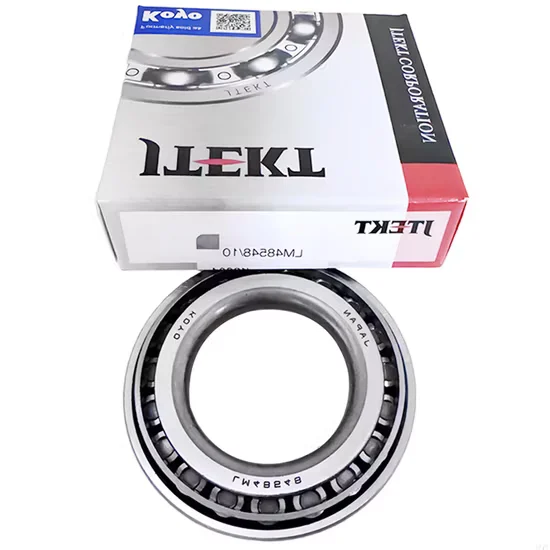
These are the Koyo / JTEKT bearing types discussed above. Open any product to check its details, or quote it together with the rest of your repair.

Railway Bearings
Genuine Koyo 32011 32209 32212 Tapered Roller Bearing for Railway Locomotive Axle Boxes
View Product
Railway Bearings
Genuine Koyo Tapered Roller Bearings 32019 32020 32021 32022 32024 for Railway Machinery
View Product
Tapered Roller Bearings
Genuine Koyo Tapered Roller Bearing 32212 32213 32214 32215 32216 for Fan Spare Parts
View Product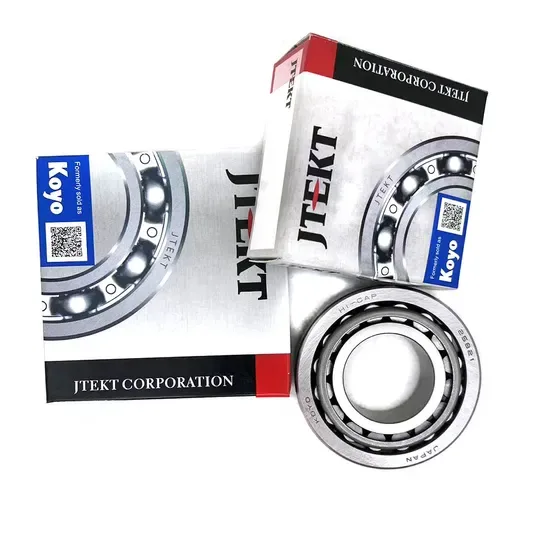
Tapered Roller Bearings
Koyo 32207 30208 30307 Tapered Roller Bearing Genuine Supplier
View ProductKeep reading
More bearing selection guides for repair shops
Practical guides from KOYO Bearing Supplier on identifying Koyo / JTEKT bearings for farm machinery, construction equipment and power transmission repairs.
 Applications & Industries
· 8 min read
Small Engine Crankshaft Bearings Wholesale Supplier
Selecting the correct Bearings in Small Engine Crankshafts requires strict clearance matching and material verification rather than simple part number lookup. Standard units often…
Read the Guide Applications & Industries · 7 min read
Forklift Mast Bearings Wholesale Supplier | Genuine SKF FAG NSK Bulk
Selecting forklift mast bearings requires matching groove profiles and clearances to harsh environments to prevent premature seizure. Sourcing only genuine SKF, FAG, and NSK…
Read the Guide Applications & Industries · 6 min read
Outboard Lower Unit Bearings Wholesale Supplier
Prevent catastrophic gearcase failures by selecting Bearings in Outboard Lower Units that balance high-speed load capacity with strict corrosion resistance. Learn why standard tapered…
Read the Guide
Bearing enquiry
Send your machine details. Get a written Koyo / JTEKT quote.
KOYO Bearing Supplier quotes a single bearing position or every bearing in an assembly on one enquiry, matched to your machine model and application, with model, quantity, price, lead time and quote validity in writing.
- WhatsApp+1 (702) 981-5880
- Emailinfo@koyoome.com
- Address8 Research Drive, Greenville, SC 20627, USA
"When a Koyo bearing failed on a harvest machine during the season, we needed a replacement urgently. The supplier identified the correct Koyo reference, shipped same-day, and the machine was back in the field within the day."

Request a Bearing Quote
Tell us the machine and the bearing position. Photos of the markings can follow on WhatsApp.