
Mixed Auto Bearing Orders for Parts Stores: Wholesale Supplier
Most mixed bearing orders fail not because of the parts, but because of the packaging.
To succeed with mixed auto bearing orders for parts stores, you must bypass standard industrial palletizing and insist on retail-ready small box packaging sorted by vehicle application. This approach eliminates destination port repacking costs and accelerates shelf placement, turning a logistical burden into a competitive advantage for regional distributors.
I still remember the email from a client in Latin America. It wasn’t polite. He had ordered a full container of deep groove ball bearings and tapered roller bearings, expecting a diverse mix suitable for his chain of auto parts stores. The manufacturer, following standard industrial protocol, had stacked everything onto large wooden pallets, wrapped in stretch film, with only a master list attached to the outside. When the container arrived at the destination port, the reality hit. There were no individual boxes, no barcode labels, and no separation by model. My client had to hire a team of temporary workers to manually sort thousands of loose bearings into identifiable groups before they could even be priced for sale. The labor cost ate up his entire margin for that quarter. That incident changed how I view supply chains. It taught me that for auto after-market suppliers, the product is only half the battle; the other half is how it arrives at the shelf.
The disconnect happens because most bearing suppliers think in terms of factories, while auto parts stores think in terms of SKUs. A factory wants to move weight; a store wants to move units. When you place mixed auto bearing orders for parts stores, you are not just buying steel rings and rolling elements. You are buying a solution that needs to fit into a specific slot on a shelf, ready for a mechanic to grab and install. If the packaging does not support this workflow, the value of the genuine brands inside is lost in the chaos of sorting.
Why Do Mixed Auto Bearing Orders Fail at Destination Ports?
Lack of retail-ready small box packaging leads to massive repacking costs and inventory confusion.
The primary reason mixed shipments fail is the assumption that “mixed” simply means different part numbers in one container. In industrial MRO scenarios, this works fine. A steel plant does not care if the spherical roller bearings arrive in bulk crates; they will be installed immediately by maintenance teams. However, auto parts stores operate on a completely different logic. They serve hundreds of different vehicle models, each requiring specific bearing sizes. A single store might stock fifty different types of wheel hub bearings alone.
When a distributor receives a container where all these SKUs are jumbled together in bulk packaging, the immediate task is identification. Without individual packaging that clearly states the part number, brand, and application, every single unit must be handled multiple times. First, it is removed from the pallet. Second, it is measured or checked against a catalog. Third, it is repacked into a sellable unit. This triple-handling process is expensive and prone to error.
Consider the case of a distributor in the Middle East who switched from bulk mixing to pre-sorted kits. Previously, his team spent weeks sorting incoming containers. By demanding that the supplier group bearings by vehicle system—such as “transmission series” or “wheel end series”—and pack them in labeled small boxes, he reduced the time from unloading to shelving by a significant margin. The bearings were no longer just metal components; they were ready-to-sell products.
This is where the concept of mixed auto bearing orders for parts stores becomes critical. It is not about reducing the variety; it is about organizing the variety before it leaves the factory. If you are sourcing from a supplier who only offers industrial bulk packing, you are importing a problem, not a solution. You need a partner who understands that a box of NSK or FAG bearings must look like a retail product, not a factory spare part. The packaging must include clear labeling, model-specific grouping, and protection that survives the final mile to the repair shop.
How to Structure a Mixed-Brand Bearing Package for Parts Stores?
Combine premium international brands with reliable domestic lines based on local market tiers to maximize coverage and profitability.
A common mistake among new distributors is assuming that stocking only top-tier international brands like SKF, TIMKEN, or NTN is the safest route. While these brands command trust, they also come with higher price points and tighter margins. In many emerging markets, such as parts of Africa and Southeast Asia, there is a substantial segment of older vehicles and price-sensitive customers who do not require premium specifications for every application.
The smart strategy is to create a tiered mix. Use established global brands for high-stress, safety-critical applications like wheel hubs and transmission inputs. For less critical or high-wear items like idler pulleys or water pump bearings, introduce reliable domestic Chinese brands such as ZWZ, HRB, or LYC. These manufacturers have improved their quality control significantly and offer genuine products that meet ISO standards, providing a viable alternative for budget-conscious repairs.
For example, a distributor in West Africa found that offering a “Premium” and “Standard” option for each popular SKU increased his total sales volume. Customers who could not afford the imported brand would still buy from him rather than going to a competitor. This approach requires careful selection. You cannot simply pick the cheapest option. You must verify that the domestic line has consistent batch quality and proper traceability.
When structuring your mixed auto bearing orders for parts stores, ask your supplier for a cross-brand equivalent verification. They should be able to tell you which domestic model corresponds to which international part number in terms of dimensions and load capacity. This allows you to build a catalog that offers choices without confusing your sales team. The goal is to cover the entire market spectrum, from the taxi driver who needs the cheapest fix to the fleet owner who demands the longest life.
What Are the Packaging Requirements for Auto Aftermarket Distributors?
Clear labeling, model-specific grouping, and ready-to-shelf small boxes are mandatory for efficient operations.
Packaging is often an afterthought in bearing procurement, but for auto parts stores, it is a primary sales tool. The box must do three things: protect the bearing, identify the bearing, and appeal to the buyer. Industrial packaging, which often uses simple oil paper and cardboard dividers, is insufficient for retail environments. These packages are prone to damage during handling and lack the visual cues needed for quick identification.
The ideal packaging for mixed auto bearing orders for parts stores includes individual color boxes or high-quality white boxes with printed labels. Each label must contain the part number, brand, origin, and crucially, the vehicle application. A mechanic or counter staff should be able to look at the box and know immediately if it fits a 2015 Toyota Hilux or a 2018 Ford Ranger.
Furthermore, the internal packaging must prevent corrosion. Bearings are sensitive to humidity, especially during long sea freight journeys. High-quality grease and vapor-corrosion inhibitor (VCI) paper are essential. If a bearing arrives with surface rust, it is unsellable, regardless of the brand. I have seen entire batches rejected because the supplier skipped the VCI step to save a few cents per unit. The cost of replacing those units far exceeded the savings.
Another key requirement is the outer carton configuration. Instead of random mixing, cartons should be grouped by category. For instance, one carton might contain only deep groove ball bearings for electric motors, while another contains tapered roller bearings for wheel ends. This makes inventory counting and restocking much faster. When you negotiate with your supplier, specify that you want “shelf-ready” packaging. This term signals that you understand the retail side of the business and expect the supplier to adapt their output accordingly.
How to Verify Quality in a Mixed-Batch Bearing Order?
Request traceability documents and cross-brand equivalent verification for every SKU to ensure consistency.
Mixing brands and sizes increases the complexity of quality control. With a single-brand order, you can rely on the brand’s reputation. With a mixed order, you must verify each component. The risk is not just counterfeit goods, but also inconsistent quality within legitimate brands. Even reputable manufacturers can have variations between production batches.
To mitigate this, require material certificates and heat treatment reports for each batch. While you may not test every bearing, having the documentation ensures that the supplier is sourcing from authorized channels. For domestic brands, ask for proof of ISO certification and recent audit reports. This is not just bureaucracy; it is your insurance policy against returns and warranty claims.
Cross-brand verification is also vital. If you are substituting a premium brand with a domestic alternative for certain SKUs, you must ensure the dimensional tolerances match. A slight deviation in internal clearance can lead to premature failure. A professional supplier will provide a comparison sheet showing that the domestic equivalent meets the same P0 or P6 precision standards as the international original.
Do not rely on visual inspection alone. Two bearings may look identical but have different internal geometries. Trust the data, not the appearance. When you place mixed auto bearing orders for parts stores, make quality verification a part of the contract, not an optional extra. This discipline protects your reputation with your own customers, who rely on you for parts that work.
Conclusion
Success in aftermarket distribution depends on treating packaging and brand mix as strategic tools, not logistical details.
Mixed auto bearing orders for parts stores require a shift from industrial thinking to retail thinking. By demanding retail-ready packaging, structuring a tiered brand mix, and enforcing strict quality verification, distributors can reduce hidden costs and increase market coverage. The goal is to deliver products that are ready to sell the moment they leave the container, ensuring that your inventory works for you, not against you.
Mentioned in this article
Koyo / JTEKT bearings from this guide
These are the Koyo / JTEKT bearing types discussed above. Open any product to check its details, or quote it together with the rest of your repair.
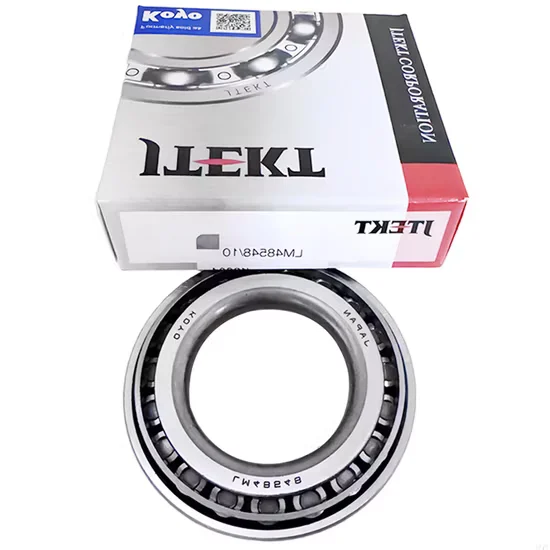
Tapered Roller Bearings
Genuine KOYO 32007 Tapered Roller Bearing Wholesale Supplier
View Product
Tapered Roller Bearings
Genuine KOYO 32006 Taper Roller Bearing Wholesale Supplier
View Product
Cylindrical Roller Bearings
Koyo NSK N408e Cylindrical Roller Bearing Genuine Wholesale Supplier
View Product
Cylindrical Roller Bearings
Koyo N2305e Cylindrical Roller Bearing Genuine Wholesale Supplier
View ProductKeep reading
More bearing selection guides for repair shops
Practical guides from KOYO Bearing Supplier on identifying Koyo / JTEKT bearings for farm machinery, construction equipment and power transmission repairs.
Procurement & Trade FAQs · 7 min read
Rebuild Kit Supply for Transmission Shops: Wholesale Bearing Supplier
Transmission rebuild kit supply depends on accurate HS codes and detailed BOMs to prevent customs delays. Learn how mixed bearing consolidation and robust packaging…
Read the Guide Procurement & Trade FAQs
· 7 min read
Genuine Bearing Stock Programs for Motorcycle Dealers: Wholesale Supplier
Optimize Motorcycle Dealer Stock Programs by balancing cross-brand bearing equivalency, genuine traceability, and flexible MOQs to prevent costly warranty claims. Verify dimensional tolerance and…
Read the Guide Procurement & Trade FAQs · 7 min read
Express Shipping for Urgent Bearing Repairs: Global Wholesale Supplier
Master express shipping for urgent bearing replacements by prioritizing customs clearance over flight speed to eliminate port bottlenecks. Optimize volumetric weight, consolidate mixed-brand orders,…
Read the Guide
Bearing enquiry
Send your machine details. Get a written Koyo / JTEKT quote.
KOYO Bearing Supplier quotes a single bearing position or every bearing in an assembly on one enquiry, matched to your machine model and application, with model, quantity, price, lead time and quote validity in writing.
- WhatsApp+1 (702) 981-5880
- Emailinfo@koyoome.com
- Address8 Research Drive, Greenville, SC 20627, USA
"When a Koyo bearing failed on a harvest machine during the season, we needed a replacement urgently. The supplier identified the correct Koyo reference, shipped same-day, and the machine was back in the field within the day."

Request a Bearing Quote
Tell us the machine and the bearing position. Photos of the markings can follow on WhatsApp.