
Mitsubishi Fuso Truck Bearings Wholesale Supplier
Identical part numbers do not guarantee identical performance.
Selecting the correct bearings for Mitsubishi Fuso trucks requires strict matching of internal clearance and heat treatment specifications to prevent catastrophic wheel hub failures under heavy loads. A generic replacement often lacks the precise thermal expansion gap needed for high-speed logistics or the robust cage structure required for mining transport, leading to premature seizure and axle damage.
I still remember the silence in the warehouse after a call from a fleet operator in the Middle East. He had ordered a batch of tapered roller bearings for his Mitsubishi Fuso super great series trucks. To meet a tight deadline, I had authorized a mixed shipment where two different cage types were included under the same commercial reference. The parts looked identical to the naked eye. Within two thousand kilometers, multiple hubs seized due to excessive heat generation. The resulting downtime and axle replacements cost far more than the initial savings on the bearings. That incident shifted my entire approach to quality control. Now, every bearing is verified for internal clearance and material consistency before it leaves the facility.
This experience highlights why sourcing strategy matters as much as technical specification. For distributors and MRO operators, understanding the nuance behind the part number is critical. This guide breaks down the technical requirements for Fuso bearings, offering a clear path to reliable procurement.
Why Do Mitsubishi Fuso Wheel Hubs Fail Prematurely?
Thermal seizure is rarely a lubrication issue alone; it is primarily a clearance mismatch problem.
Wheel hub failures in heavy-duty trucks like the Mitsubishi Fuso are often misdiagnosed as simple wear and tear. In reality, the root cause is frequently an incompatibility between the bearing’s internal clearance and the operating temperature range. When a truck operates under heavy load, the components expand. If the initial clearance is too tight, this expansion eliminates the necessary running gap, causing metal-to-metal contact, rapid heat buildup, and eventual locking of the hub.
Consider the physics of a fully loaded dump truck climbing a grade. The radial load on the wheel bearings increases significantly, generating heat. Simultaneously, the brake drums radiate additional thermal energy into the hub assembly. A standard clearance bearing may not accommodate this combined thermal expansion. The rollers begin to skid rather than roll, creating microscopic scars on the raceways. Over time, these scars deepen into spalling, leading to vibration and noise before total failure occurs.
In one case involving a logistics company in Southeast Asia, a fleet experienced repeated high-speed overheating issues. The investigation revealed that the aftermarket bearings supplied had a standard C2 clearance, whereas the OEM specification for those specific high-speed highway models required a C3 clearance. The tighter clearance left no room for thermal expansion at sustained high RPMs. Switching to the correct clearance specification resolved the overheating without changing the lubricant or driving habits.
Understanding this mechanism is vital for anyone acting as a Mitsubishi Fuso truck bearings wholesale supplier. It is not enough to match the outer dimensions. The internal geometry must align with the vehicle’s intended duty cycle. Failure to account for this leads to warranty claims and lost trust from end-users who expect durability from their heavy equipment.
How to Match Bearing Clearances for Specific Fuso Models?
Clearance selection depends on load severity and speed, not just the truck model year.
Choosing between C3, C4, or standard clearances is a technical decision that impacts longevity. Many buyers assume that a heavier truck always needs more clearance, but this is an oversimplification. The key is balancing the need for thermal expansion against the requirement for precise load distribution. Too much clearance can lead to uneven load sharing among rollers, causing early fatigue in high-radial-load scenarios.
For mining and construction applications, where speeds are low but loads are extreme, a moderate clearance is often preferred to ensure maximum contact area. However, for long-haul logistics vehicles that maintain high speeds for extended periods, a larger clearance is necessary to accommodate heat-induced expansion. The table below outlines the general selection logic based on operational conditions.
| Operating Condition | Load Type | Speed Range | Recommended Clearance Class | Rationale |
|---|---|---|---|---|
| Long-Haul Logistics | Moderate Radial | High | C3 | Accommodates thermal expansion at sustained high RPM |
| Mining/Quarry Transport | Heavy Radial | Low to Moderate | Standard or C3 | Maximizes load distribution; minimal thermal gain |
| Mixed Urban Delivery | Variable | Variable | C3 | Balances stop-start heating with variable loads |
| Heavy-Duty Towing | High Radial/Axial | Low | Standard | Prioritizes rigidity and load capacity over thermal gap |
Note that these are general guidelines. Specific OEM technical service bulletins should always be consulted for definitive specifications.
A European transport operator once reported inconsistent bearing life across their fleet of Fuso fighters. Some trucks lasted twice as long as others despite identical maintenance schedules. Upon review, it was found that the shorter-lived trucks were used for high-speed highway freight, while the longer-lasting ones were used for regional delivery. The bearings installed were all standard clearance. By switching the highway units to C3 clearance bearings, the fleet standardized the lifespan across all vehicles. This demonstrates that application context dictates the correct technical specification.
As a Mitsubishi Fuso truck bearings wholesale supplier, providing this level of technical guidance adds value beyond simple transaction. It helps customers avoid the costly mistake of applying a one-size-fits-all solution to diverse operational needs.
What Physical Checks Prevent Catastrophic Axle Damage?
Visual and tactile verification of cage type and heat treatment is non-negotiable before installation.
Relying solely on packaging labels is insufficient for critical components. Counterfeit or substandard bearings often mimic the external appearance of genuine parts but fail in internal quality. A rigorous physical inspection can identify potential failures before they reach the wheel hub. The first check is the cage material and construction. Steel cages offer higher strength for heavy loads, while polymer cages reduce weight and friction but may have lower thermal limits. Mixing these up can lead to cage deformation under stress.
Heat treatment is another critical factor. The hardness of the bearing steel must be consistent throughout the raceway and rollers. Inconsistent hardness leads to premature spalling. While measuring exact hardness requires specialized equipment, checking for proper surface finish and absence of grinding burns is a practical field test. A blue or brown discoloration on the raceway indicates overheating during manufacturing or previous use, which compromises the steel’s structural integrity.
Internal clearance measurement using a dial indicator is the most reliable method for verification. This tool measures the axial and radial play within the bearing assembly. Comparing these measurements against the manufacturer’s tolerance tables ensures the bearing meets the required specification.
In a recent audit of a supply chain in Latin America, a batch of bearings was flagged because the cages showed slight variations in rivet placement. While functional, this inconsistency indicated a lack of precision in the manufacturing process. Further testing revealed that the internal clearance was outside the acceptable range for C3 specifications. Rejecting this batch prevented potential failures in a fleet of heavy-duty trucks.
These checks are essential for maintaining reliability. For a Mitsubishi Fuso truck bearings wholesale supplier, implementing such quality control steps builds credibility and ensures that only compliant products reach the market. It transforms the supply role from mere distribution to technical partnership.
How to Source Genuine Fuso Bearings for Mixed Fleets?
Traceability and consolidated sourcing reduce risk in multi-brand inventory management.
Managing a mixed fleet of trucks often means dealing with various bearing brands and specifications. Sourcing these components individually from multiple vendors increases complexity and the risk of receiving non-compliant parts. A consolidated sourcing strategy simplifies procurement by providing a single point of accountability for quality and documentation.
Genuine bearings come with complete traceability documentation, including material certificates and batch numbers. This documentation is crucial for verifying authenticity and addressing any quality issues that may arise. Without it, distinguishing between genuine and counterfeit parts becomes nearly impossible.
One-stop sourcing solutions allow buyers to procure mixed-brand bearing packages tailored to their specific fleet needs. This approach ensures that all components meet the required standards, regardless of the original manufacturer. It also facilitates better inventory management, as suppliers can provide cross-brand equivalent model consultation. This technical support helps identify suitable alternatives when original parts are unavailable, ensuring minimal downtime.
For example, a mining operation in Africa needed to replace bearings for both their haul trucks and support vehicles. By working with a supplier who offered mixed-brand consolidation, they were able to source SKF, FAG, and TIMKEN bearings in a single shipment. The supplier provided technical verification for each part, ensuring compatibility with the specific Fuso models in use. This streamlined process reduced lead times and administrative overhead significantly.
The ability to offer flexible MOQs, from single-unit emergency spares to full container loads, further enhances the value of such a partnership. It allows businesses to scale their procurement according to demand without being constrained by rigid minimum order requirements. For a Mitsubishi Fuso truck bearings wholesale supplier, this flexibility is a key competitive advantage in serving diverse global markets.
Conclusion
Precision in specification prevents expensive operational failures.
Selecting bearings for Mitsubishi Fuso trucks demands more than matching part numbers; it requires a deep understanding of internal clearance, load conditions, and material quality. By prioritizing technical verification and traceable sourcing, operators can avoid the high costs associated with premature wheel hub failures. Reliable supply chains that offer consolidated, quality-assured products are essential for maintaining fleet uptime and safety.
Mentioned in this article
Koyo / JTEKT bearings from this guide
These are the Koyo / JTEKT bearing types discussed above. Open any product to check its details, or quote it together with the rest of your repair.
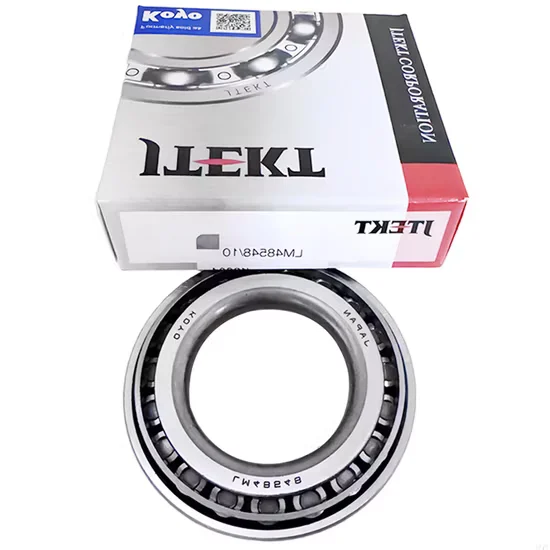
Tapered Roller Bearings
Genuine KOYO 32007 Tapered Roller Bearing Wholesale Supplier
View Product
Tapered Roller Bearings
Genuine KOYO 32006 Taper Roller Bearing Wholesale Supplier
View Product
Cylindrical Roller Bearings
Koyo NSK N408e Cylindrical Roller Bearing Genuine Wholesale Supplier
View Product
Cylindrical Roller Bearings
Koyo N2305e Cylindrical Roller Bearing Genuine Wholesale Supplier
View ProductKeep reading
More bearing selection guides for repair shops
Practical guides from KOYO Bearing Supplier on identifying Koyo / JTEKT bearings for farm machinery, construction equipment and power transmission repairs.
Applications & Industries · 7 min read
Small Engine Crankshaft Bearings Wholesale Supplier
Selecting the correct Bearings in Small Engine Crankshafts requires strict clearance matching and material verification rather than simple part number lookup. Standard units often…
Read the Guide Applications & Industries · 7 min read
Forklift Mast Bearings Wholesale Supplier | Genuine SKF FAG NSK Bulk
Selecting forklift mast bearings requires matching groove profiles and clearances to harsh environments to prevent premature seizure. Sourcing only genuine SKF, FAG, and NSK…
Read the Guide Applications & Industries · 6 min read
Outboard Lower Unit Bearings Wholesale Supplier
Prevent catastrophic gearcase failures by selecting Bearings in Outboard Lower Units that balance high-speed load capacity with strict corrosion resistance. Learn why standard tapered…
Read the Guide
Bearing enquiry
Send your machine details. Get a written Koyo / JTEKT quote.
KOYO Bearing Supplier quotes a single bearing position or every bearing in an assembly on one enquiry, matched to your machine model and application, with model, quantity, price, lead time and quote validity in writing.
- WhatsApp+1 (702) 981-5880
- Emailinfo@koyoome.com
- Address8 Research Drive, Greenville, SC 20627, USA
"When a Koyo bearing failed on a harvest machine during the season, we needed a replacement urgently. The supplier identified the correct Koyo reference, shipped same-day, and the machine was back in the field within the day."

Request a Bearing Quote
Tell us the machine and the bearing position. Photos of the markings can follow on WhatsApp.