Koyo Auto Bearings Lead Times: Wholesale Supplier for Bulk Orders
Factory direct is not always faster.
The standard lead time for Koyo auto bearings ordered directly from the manufacturer ranges from sixty to ninety days, depending on production schedules and minimum order quantities. In contrast, sourcing from distributors with verified spot inventory can reduce delivery to one to seven days, which is critical for urgent maintenance and aftermarket replenishment.
I still remember the panic in a workshop in Southeast Asia when a fleet of commercial trucks sat idle because wheel hub bearings were stuck in a factory production queue. The local mechanic had assumed that ordering directly from the source would guarantee the quickest turnaround. Instead, the rigid manufacturing cycle and high minimum order requirements meant the parts would not arrive for nearly two months. That delay cost the fleet operator significantly more in downtime penalties than the slight premium paid for immediate stock. This experience reshaped how I approach procurement, shifting focus from pure unit cost to total availability risk.
Understanding the difference between these two supply channels is essential for any buyer managing inventory for automotive repair groups or industrial maintenance. The choice is not merely about price but about aligning procurement strategy with operational urgency.
What is the standard factory lead time for Koyo auto bearings?
Factory orders follow strict production batches rather than individual buyer urgency.
When you place an order for Koyo auto bearings through official manufacturing channels, you enter a queue governed by raw material availability and production slot allocation. The manufacturer does not keep every possible part number in finished goods storage. Instead, they produce in large batches to optimize efficiency. This means your order waits until the specific bearing type is scheduled for production.
The timeline usually involves several stages. First, there is the order confirmation and raw material procurement phase. Then comes the actual machining, heat treatment, and assembly. Finally, quality control checks and packaging take place before the goods are ready for shipment. For standard deep-groove ball bearings or tapered roller bearings used in high-volume vehicle models, this process might be quicker due to frequent production runs. However, for less common sizes or specific precision grades required by heavy-duty applications, the wait can extend significantly.
A key factor here is the minimum order quantity. Factories often require buyers to purchase full pallets or even container loads of a single part number to justify a production run. If your demand is lower than this threshold, you may face longer delays as the manufacturer waits to consolidate your order with others. This rigidity makes factory direct sourcing suitable for predictable, long-term planning but risky for unexpected demand spikes.
Buyers must also consider that factory lead times do not include shipping duration. Once the goods leave the production facility, they still need to clear customs and undergo international transit. This adds another layer of uncertainty, especially if documentation is not perfectly aligned with import regulations.
How does spot inventory change the delivery game for urgent orders?
Spot inventory transforms lead time from months to days.
Distributors who maintain substantial spot inventory act as a buffer between the rigid factory schedule and the volatile market demand. By stocking genuine Koyo auto bearings in advance, these suppliers can fulfill orders almost immediately. For a repair shop facing a broken-down truck or a mining operation needing an emergency replacement, this speed is invaluable. The ability to ship within one to seven days prevents costly operational halts.
The value of spot inventory lies in its flexibility. Unlike factories, distributors often allow mixed-batch orders. You can buy ten units of one bearing type and five of another, all in the same shipment. This capability is crucial for aftermarket suppliers who need to replenish a wide variety of slow-moving and fast-moving items without tying up capital in massive single-SKU volumes.
However, not all spot stock is created equal. The market is flooded with counterfeit or refurbished bearings sold as new. A professional supplier ensures that every unit in their spot inventory comes with complete traceability documentation. This includes original packaging, batch numbers, and certification papers that verify the product’s authenticity. Without these documents, the risk of installing substandard parts increases, leading to premature failure and potential liability issues.
For buyers in regions like Latin America or the Middle East, where logistics infrastructure can sometimes cause delays, having a local or regional distributor with ready stock is a strategic advantage. It reduces dependence on long international shipping lanes and minimizes exposure to freight rate fluctuations.
What hidden factors actually extend your bearing lead time?
Documentation and customs compliance are silent bottlenecks.
Even if the physical goods are ready, administrative hurdles can stall delivery. One major factor is the verification of traceability documents. Import authorities in many countries require detailed proof of origin and quality certification for mechanical parts. If the supplier cannot provide these documents instantly, customs clearance will be delayed. This is why working with a supplier who maintains rigorous record-keeping is essential.
Another hidden factor is the seasonal capacity bottleneck at factories. During peak demand periods, such as before major automotive trade shows or end-of-year inventory builds, production slots fill up quickly. Buyers who do not forecast their needs well may find themselves pushed to the back of the queue. Additionally, raw material shortages, particularly for high-grade steel, can disrupt production schedules unexpectedly.
Customs clearance itself varies widely by region. Some ports have streamlined processes for trusted traders, while others conduct thorough inspections of every container. If the bearing packaging does not meet specific labeling standards or if the declared value seems inconsistent, inspectors may hold the shipment for further review. These delays are often beyond the control of the supplier but can be mitigated by ensuring all paperwork is accurate and complete before shipment.
Buyers should also be aware of Incoterms. Choosing FOB versus CIF affects who manages the shipping process and when responsibility transfers. Misunderstanding these terms can lead to confusion over who handles customs brokerage, potentially causing unnecessary delays if the wrong party attempts to manage complex import procedures.
How to build a hybrid procurement strategy for mixed-batch orders?
Balance cost and speed by combining spot buys with factory forecasts.
A smart procurement strategy does not rely solely on one channel. Instead, it uses a hybrid approach. For high-turnover items that are frequently needed, maintaining a safety stock sourced from spot inventory ensures immediate availability. For larger, predictable volumes of standard parts, placing periodic factory orders can secure better pricing and ensure long-term supply stability.
This approach requires careful analysis of usage patterns. Identify which Koyo auto bearings are critical for emergency repairs and keep them in local stock. For less urgent, bulk requirements, plan factory orders well in advance to avoid rush fees. This balance helps stabilize cash flow by avoiding excessive capital tied up in inventory while preventing stockouts that halt operations.
Working with a supplier who offers both services simplifies this process. A professional global bearing supplier can provide spot inventory for urgent needs and manage factory direct orders for bulk projects. They can also offer technical support to help select equivalent models if a specific part is temporarily unavailable, ensuring that maintenance schedules remain on track.
Additionally, leveraging cross-brand equivalent consultation can provide alternatives when specific Koyo parts are out of stock. A knowledgeable supplier can recommend bearings from other premium brands like SKF or NSK that meet the same specifications, allowing operations to continue without compromise. This flexibility is a key advantage of working with a multi-brand distributor rather than a single-brand channel.
Conclusion
Lead time is a strategic variable, not a fixed constant.
Successful procurement of Koyo auto bearings requires understanding the trade-offs between factory direct orders and spot inventory. While factory sourcing offers cost advantages for large volumes, it comes with long lead times and rigid minimums. Spot inventory provides speed and flexibility, crucial for minimizing downtime in urgent scenarios. By adopting a hybrid strategy and partnering with a supplier who offers verified traceability and mixed-batch capabilities, buyers can optimize both cost and availability. This approach ensures that maintenance and production schedules remain resilient against supply chain disruptions.
Mentioned in this article
Koyo / JTEKT bearings from this guide
These are the Koyo / JTEKT bearing types discussed above. Open any product to check its details, or quote it together with the rest of your repair.

Tapered Roller Bearings
P5 Koyo 33010 30211 33110 32307 33208 Tapered Roller Bearing for Motor Auto Pump
View Product
Tapered Roller Bearings
Jtekt Koyo Tapered Roller Bearing 32010 30302 30303 30304 30305 30306 for Auto Parts
View Product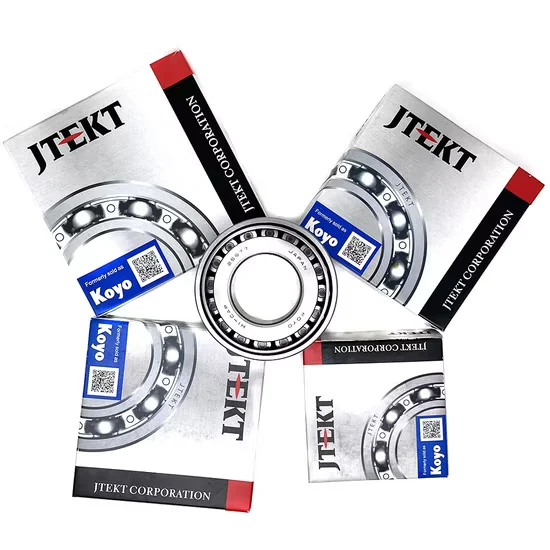
Tapered Roller Bearings
Koyo Tapered Roller Bearing 30203 30204 30205 30206 30207 for Auto Parts Wholesale
View Product
Inch Size Bearings
Koyo L420449/L420410 TRA181504 Tapered Roller Bearing for Auto Parts
View ProductKeep reading
More bearing selection guides for repair shops
Practical guides from KOYO Bearing Supplier on identifying Koyo / JTEKT bearings for farm machinery, construction equipment and power transmission repairs.
 Procurement & Trade FAQs
· 7 min read
Rebuild Kit Supply for Transmission Shops: Wholesale Bearing Supplier
Transmission rebuild kit supply depends on accurate HS codes and detailed BOMs to prevent customs delays. Learn how mixed bearing consolidation and robust packaging…
Read the Guide Procurement & Trade FAQs
· 7 min read
Genuine Bearing Stock Programs for Motorcycle Dealers: Wholesale Supplier
Optimize Motorcycle Dealer Stock Programs by balancing cross-brand bearing equivalency, genuine traceability, and flexible MOQs to prevent costly warranty claims. Verify dimensional tolerance and…
Read the Guide Procurement & Trade FAQs · 7 min read
Express Shipping for Urgent Bearing Repairs: Global Wholesale Supplier
Master express shipping for urgent bearing replacements by prioritizing customs clearance over flight speed to eliminate port bottlenecks. Optimize volumetric weight, consolidate mixed-brand orders,…
Read the Guide
Bearing enquiry
Send your machine details. Get a written Koyo / JTEKT quote.
KOYO Bearing Supplier quotes a single bearing position or every bearing in an assembly on one enquiry, matched to your machine model and application, with model, quantity, price, lead time and quote validity in writing.
- WhatsApp+1 (702) 981-5880
- Emailinfo@koyoome.com
- Address8 Research Drive, Greenville, SC 20627, USA
"When a Koyo bearing failed on a harvest machine during the season, we needed a replacement urgently. The supplier identified the correct Koyo reference, shipped same-day, and the machine was back in the field within the day."

Request a Bearing Quote
Tell us the machine and the bearing position. Photos of the markings can follow on WhatsApp.